

Forward Deployed Advisor
Execution coherence for AI at Scale
A roadmap does not execute itself.
Once AI commitments move into implementation, business intent must survive contact with technical reality, external partners, capability constraints, workflow change, adoption, cost, and new evidence.
The Forward Deployed Advisor operates in that space — close enough to implementation to understand what is really happening, but high enough above specialist work to keep the whole execution system connected to business value and leadership intent.
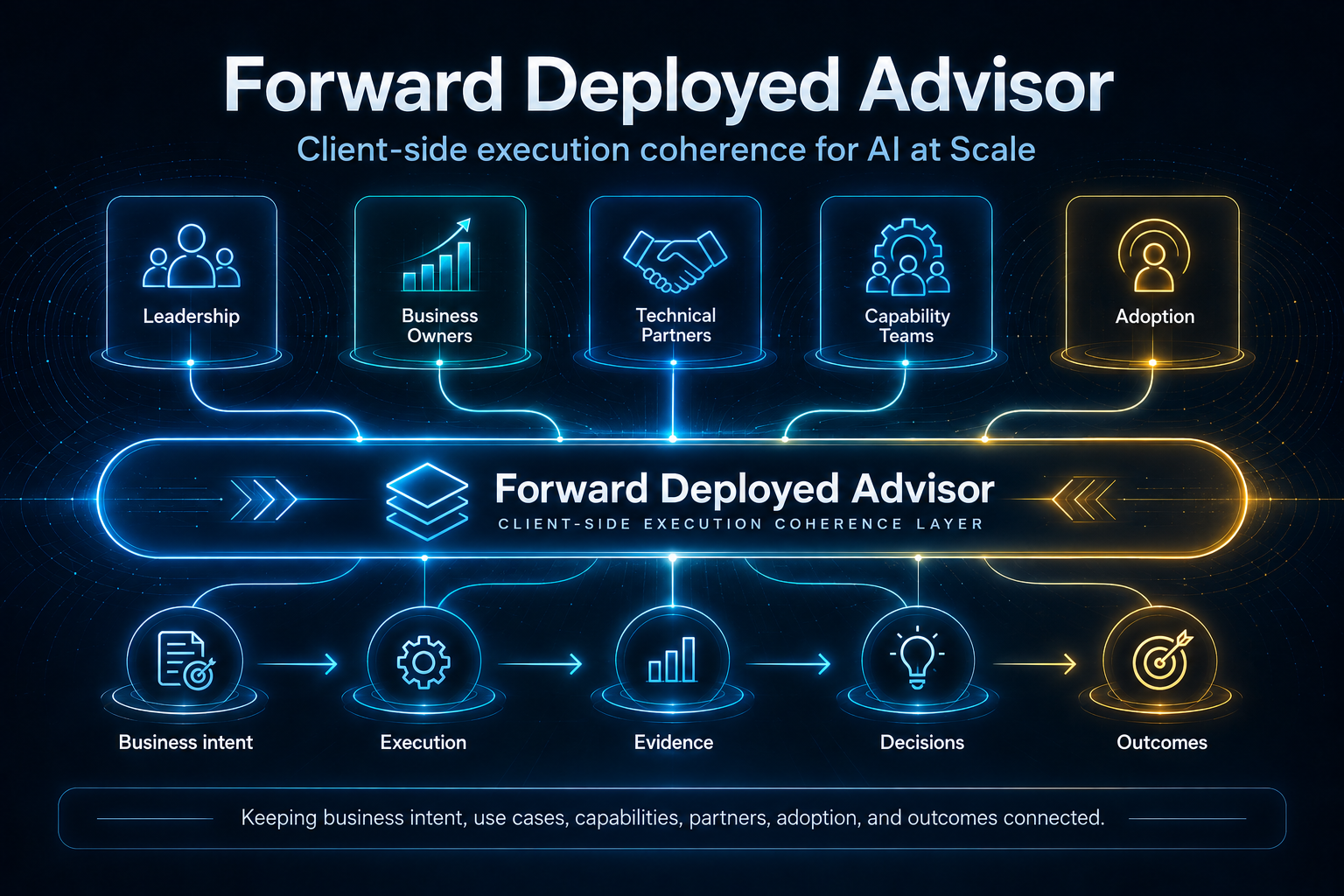
Strategy is not enough.
Technical delivery is not enough.
Someone must protect the connection between them.
The missing space between strategy and implementation
AI implementation usually already has many capable actors.
Leadership sets direction. Business owners understand customers and workflows. Technical specialists build solutions. External partners bring scarce expertise. Project managers coordinate activities. Change leads support adoption.
All of those roles are necessary.
But none automatically owns one critical question: Is everything still connected to the business logic that justified the AI commitment in the first place?
That gap becomes increasingly important as implementation spreads across multiple use cases, technical specialists, capability workstreams, and external partners. The FDA exists to keep that system coherent.
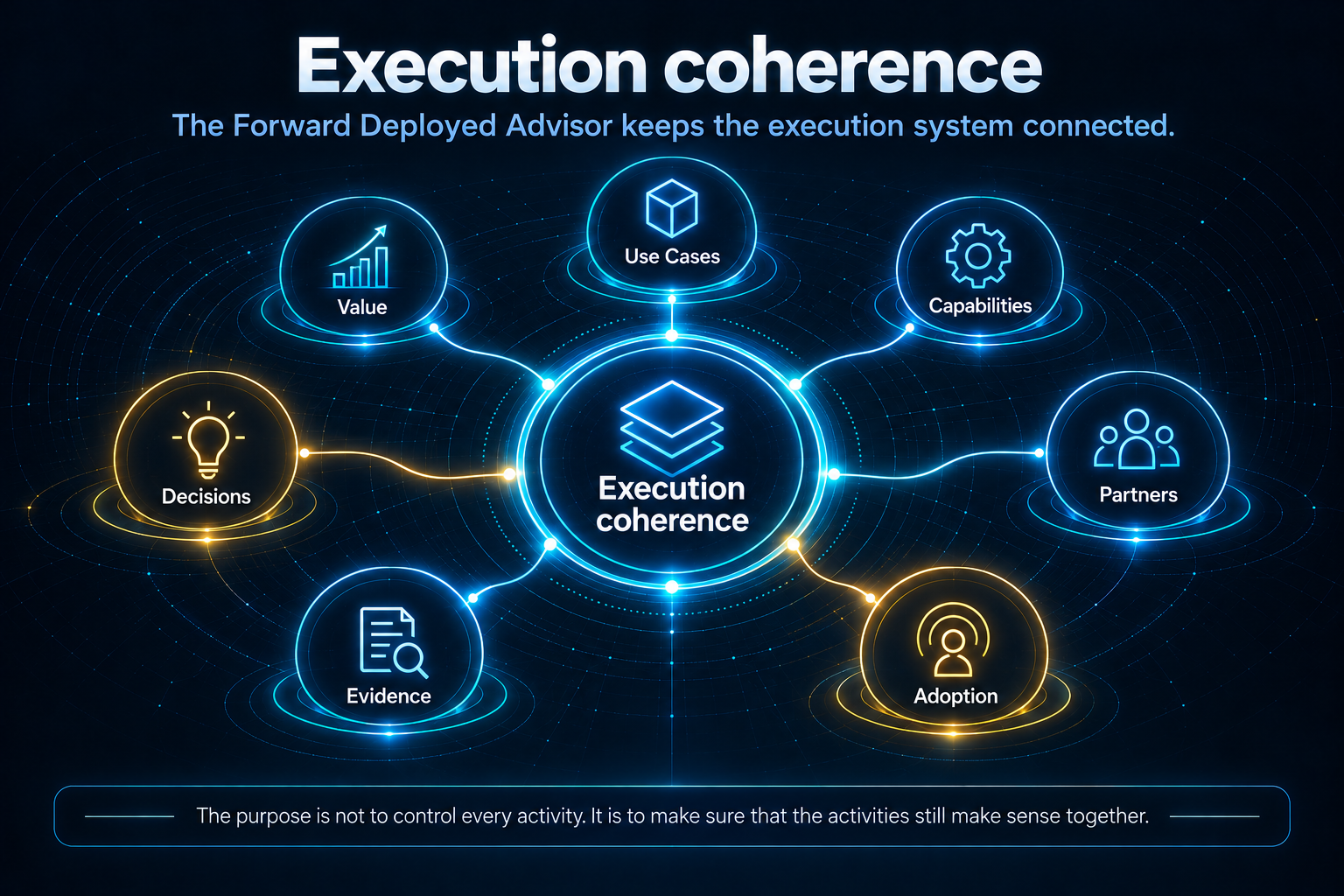
Execution coherence
The FDA stays close to implementation so that emerging technical, operational, organizational, and commercial realities can be understood in context.
The role helps recognize when:
a technical decision changes the business implications
a dependency has been underestimated
a partner proposal changes roadmap logic
a capability constraint is becoming critical
an apparent delay is actually a readiness problem
adoption is falling behind deployment
cost is changing the investment case
new evidence should trigger a new leadership decision
The purpose is not to control every activity. It is to make sure that the activities still make sense together.
Forward Deployed Advisory is delivered through Execution Support.
But when the advisor has already participated in earlier AI at Scale Method stages, the role enters execution with unusually deep context awareness.
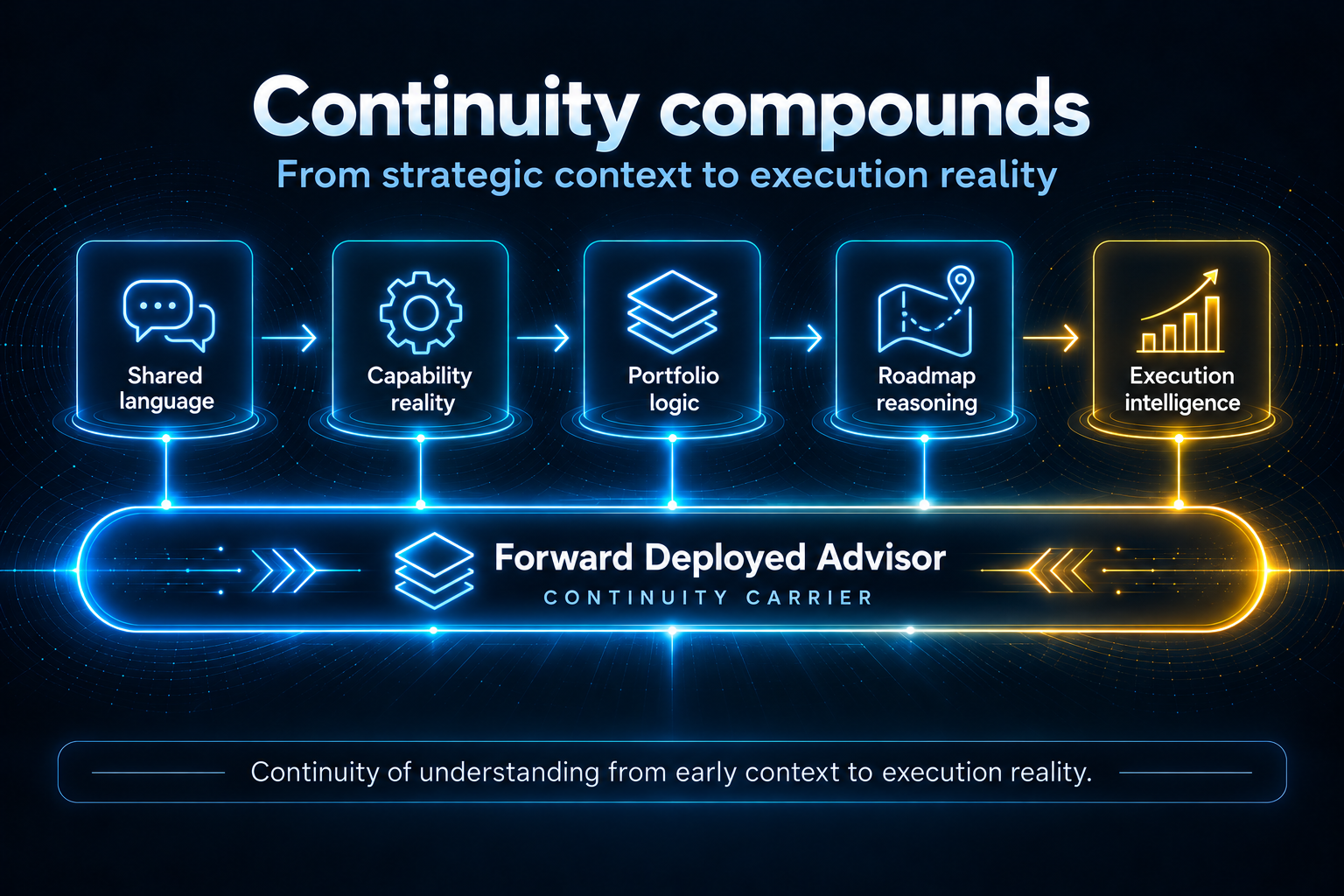
From strategic context to execution reality
The Forward Deployed Advisor is an Execution Support role — but its effectiveness can begin much earlier.
When the same advisor has participated in the AI at Scale Workshop and subsequent assessment work, execution does not begin with a cold handover.
The advisor already understands:
the leadership intent behind the AI agenda
the constraints that shaped earlier choices
how the use case portfolio was formed and prioritized
why certain capabilities matter more than others
which dependencies affected sequencing
why particular use cases were placed earlier or later
where partners were expected to contribute
which assumptions and readiness conditions sit behind the roadmap
That context becomes highly valuable once implementation begins.
The FDA is then not trying to reconstruct the reasoning behind earlier decisions from documents. The role can carry that reasoning forward as execution produces new evidence and reality begins to challenge assumptions.
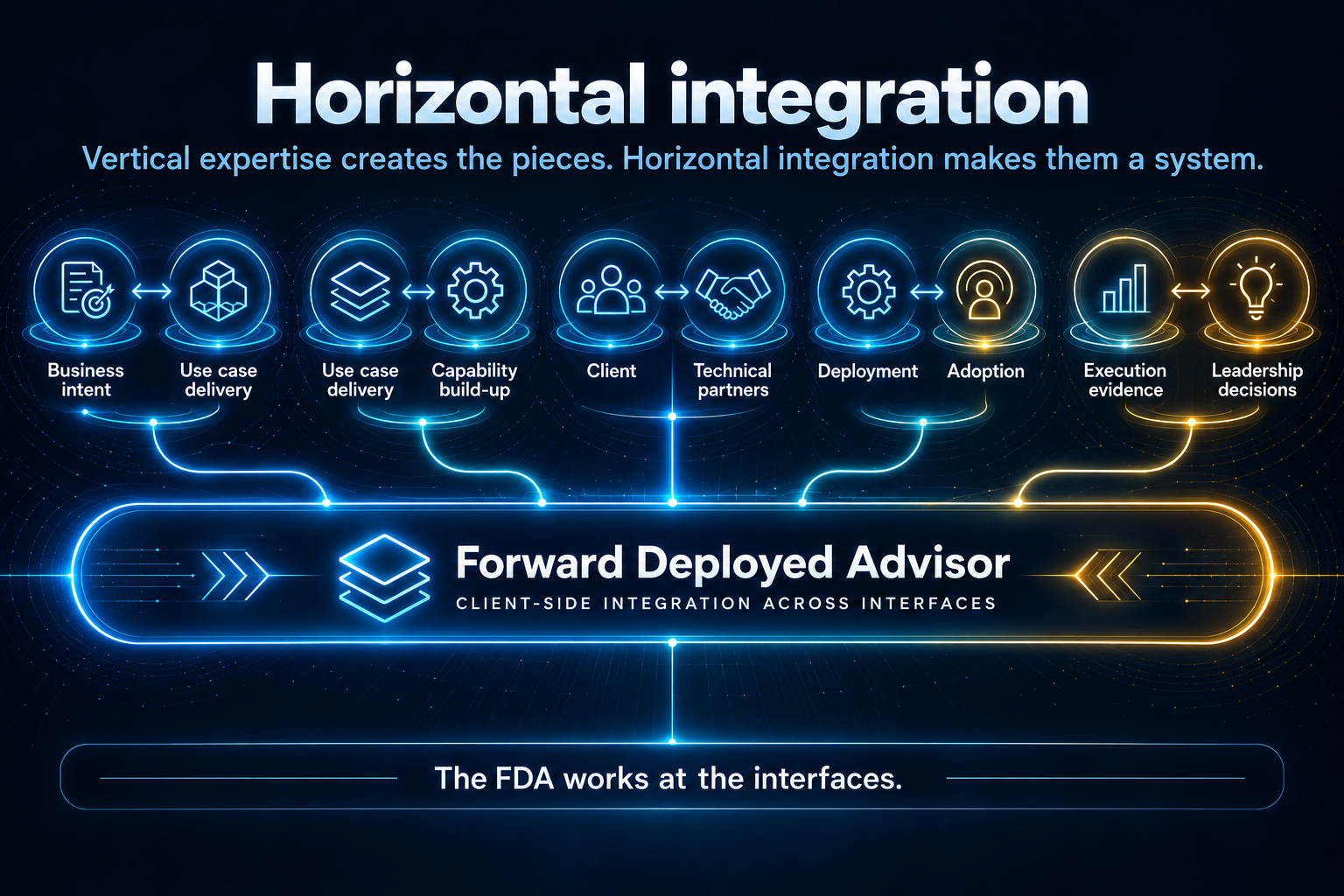
Horizontal integration
Technical specialists naturally work vertically. They go deep into their area of expertise.
The Forward Deployed Advisor works horizontally across those specialist contributions.
The FDA helps maintain five particularly important interfaces:
Business intent ↔ Use case delivery Is what is being built still solving the intended business problem?
Use case delivery ↔ Capability build-up Are capability investments driven by real use-case demand — and are improving capabilities unlocking future use cases?
Client ↔ Technical partners Is external expertise accelerating implementation without transferring business judgment, ownership, or strategic agency to the supplier?
Deployment ↔ Adoption Is the solution merely technically live, or has it genuinely entered real work?
Execution evidence ↔ Leadership decisions Is new information from implementation reaching the people who need to decide what happens next?
Protecting value at the handoffs
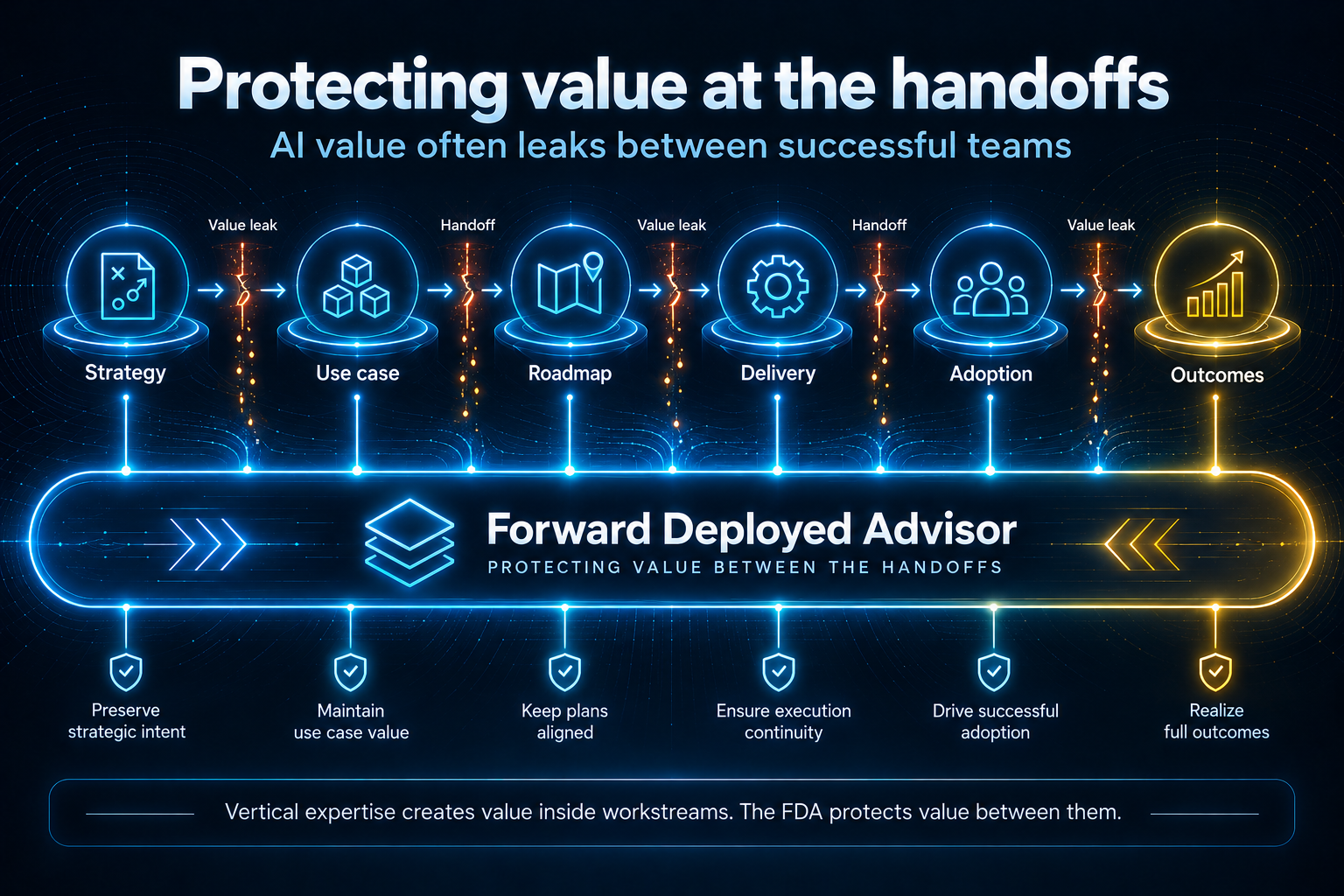
A strategy can be good. The technology can work. The implementation partner can deliver. Users can be trained. Management can receive green status reports…
…and the initiative can still create much less value than expected.
Why? Because AI value has to move through several handoffs — and important context can disappear at each one.
Common leakage points include:
strategy → use case
roadmap → delivery
use case delivery → capability build-up
client → technical partner
technical deployment → adoption
execution evidence → leadership decision
The FDA does not replace the specialists on either side of those handoffs.
The FDA protects the value between them.
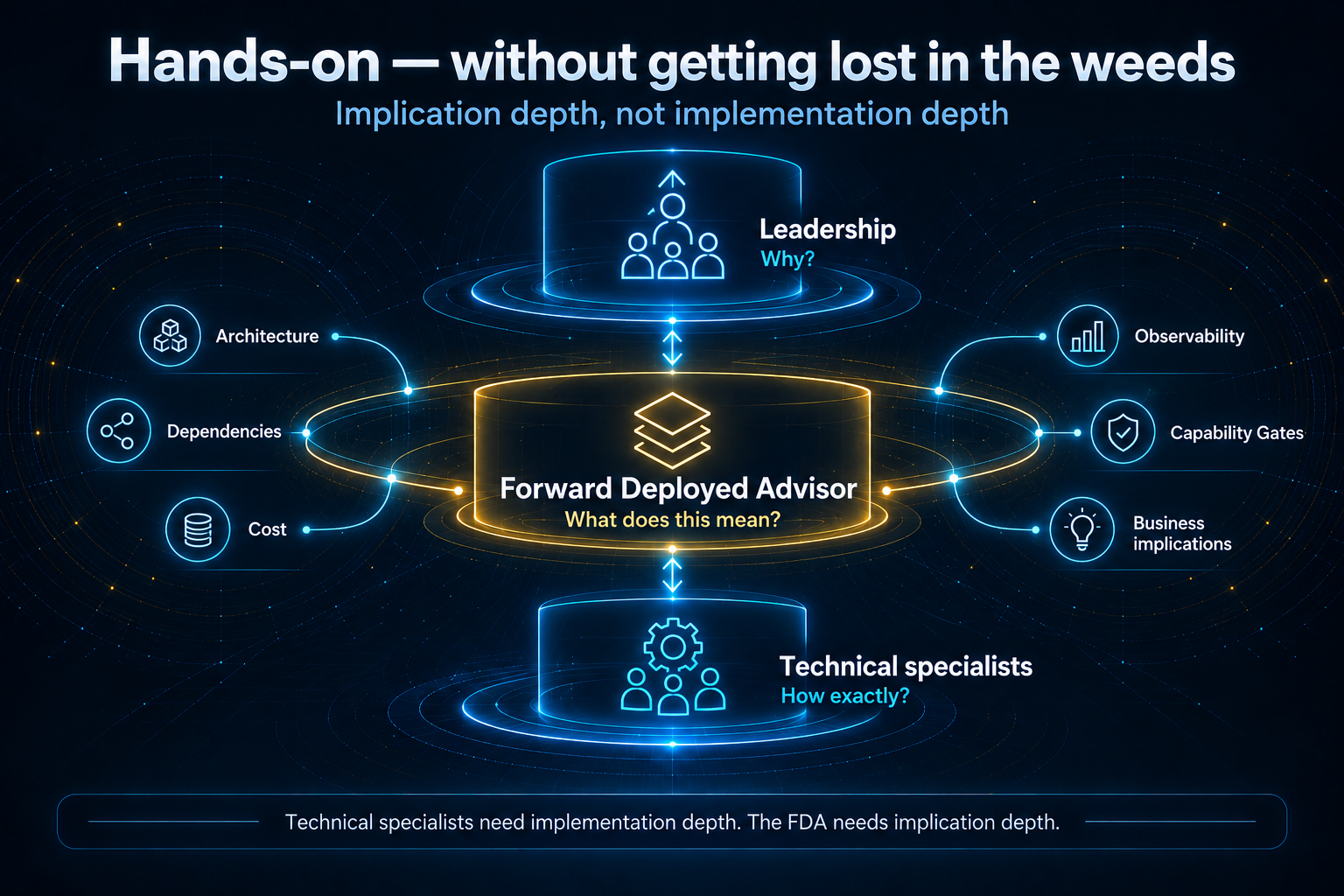
Hands-on — without getting lost in the weeds
Forward Deployed Advisory is intentionally close to technical implementation. But the FDA is not a technical vendor.
The role needs enough technical literacy to understand what architecture, interfaces, data flows, agent harnesses, observability, security, cost drivers, and lifecycle choices mean for the business, the roadmap, and the next decision.
That means being able to ask:
What are we building?
What does it depend on?
What can fail?
What is observable?
What happens when it fails?
What will it cost to operate and scale?
What does this architecture commit us to?
Does this affect a Capability Gate or future use cases?
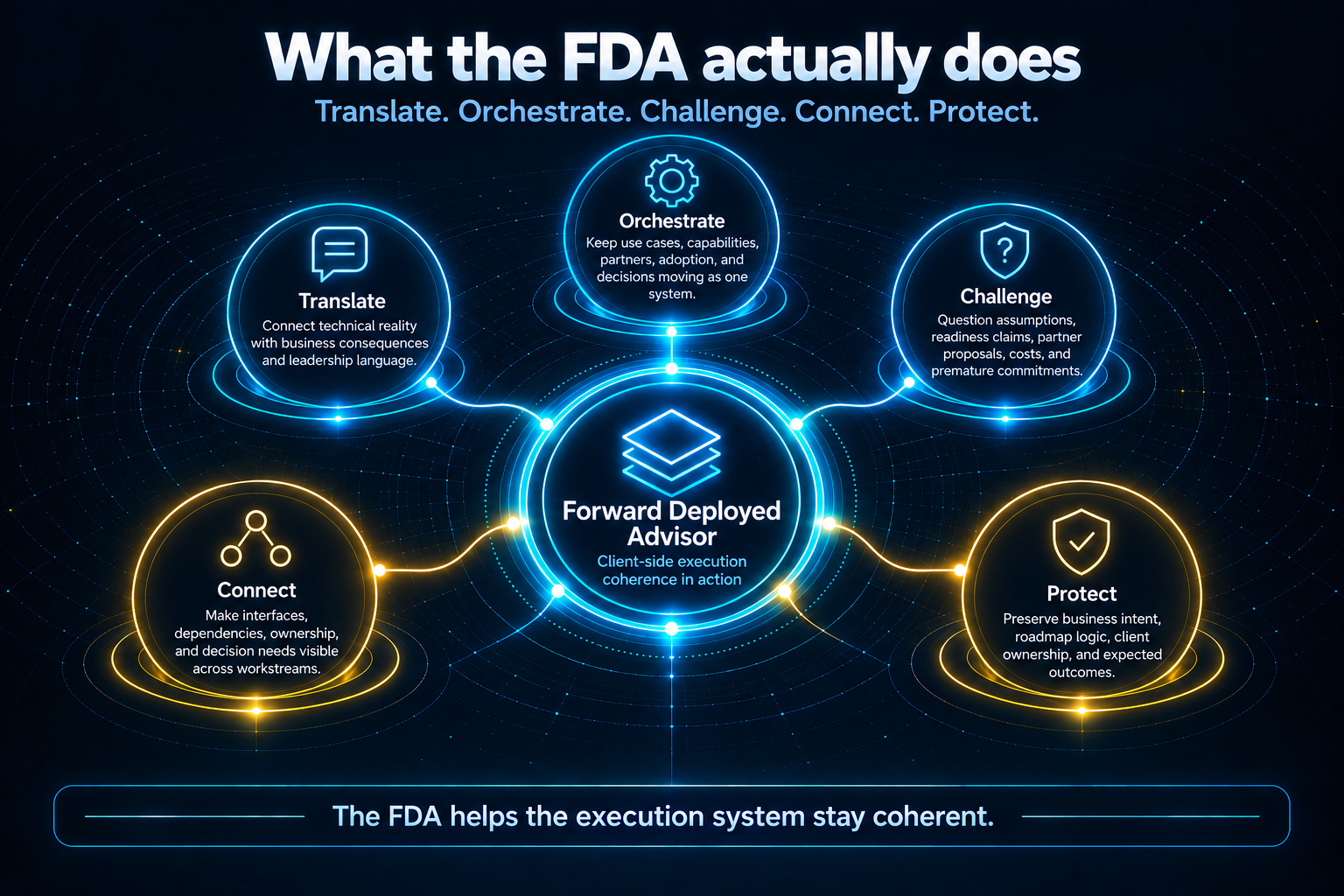
What the FDA actually does
Translate — Connect technical reality with business consequences and leadership language.
Orchestrate — Keep use cases, capability build-up, partners, dependencies, adoption, and decisions moving as one execution system.
Challenge — Question assumptions, partner proposals, readiness claims, costs, and premature commitments.
Connect — Make interfaces, dependencies, ownership, and decision needs visible across specialist workstreams.
Protect — Preserve the business intent, roadmap logic, client ownership, and expected outcomes through execution.
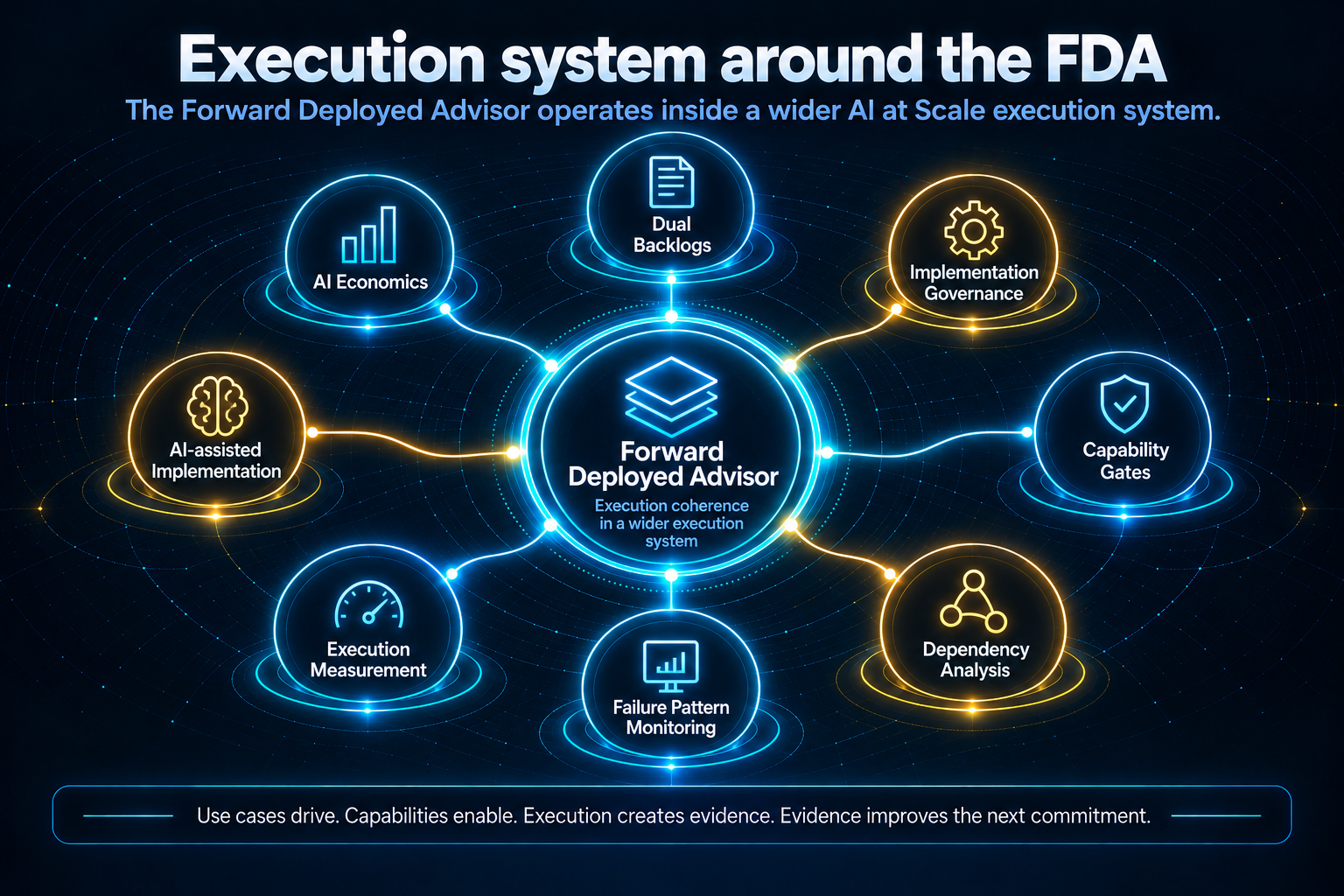
Execution system around the FDA
Forward Deployed Advisor operates inside AI at Scale Method execution system.
That system includes:
Dual Backlogs — translating roadmap intent into executable use-case and capability work
Implementation Governance — turning execution evidence into explicit decisions
Capability Gates — preventing commitment from running ahead of readiness
Dependency Analysis — keeping cross-domain constraints and enabling relationships visible
Failure Pattern monitoring — recognizing predictable breakdowns early
Execution measurement — looking beyond activity toward delivery, capability, adoption, cost, risk, and outcomes
AI-assisted implementation — reducing the analytical and coordination burden of execution
AI economics — keeping investment logic and cost-of-scale visible
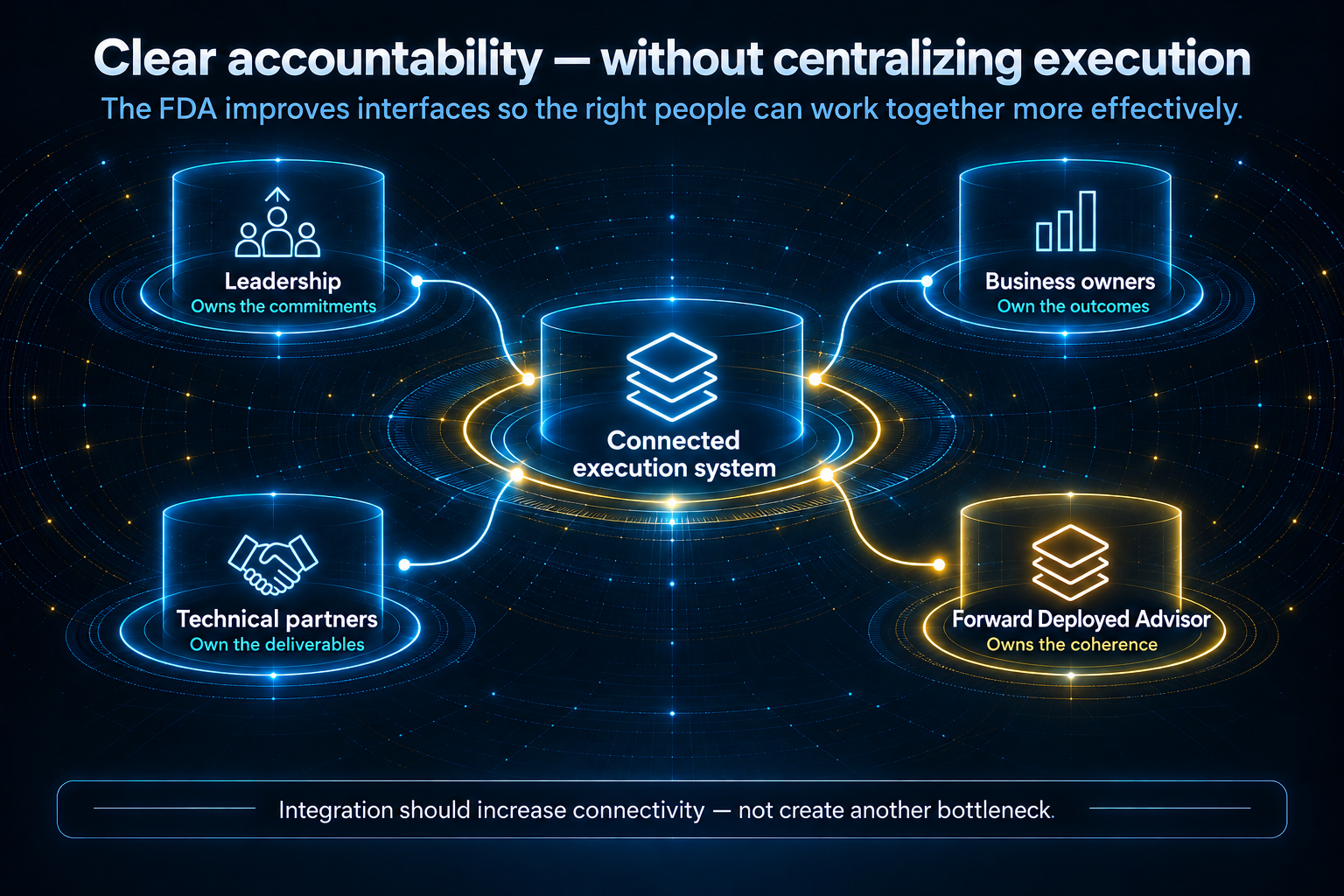
Clear accountability — without centralizing execution
Forward Deployed Advisory does not mean routing every decision, conversation, or task through one advisor.
The opposite is the goal: Improve the interfaces so that the right people can work together more effectively.
The division of responsibility remains clear:
Leadership owns the commitments.
Business owners own the outcomes.
Technical partners own their deliverables.
Forward Deployed Advisor owns the coherence.
The FDA connects information, surfaces dependencies, translates implications, exposes gaps, and brings decision needs forward — without taking over responsibilities that belong elsewhere.
Integration should increase connectivity — not create another bottleneck.
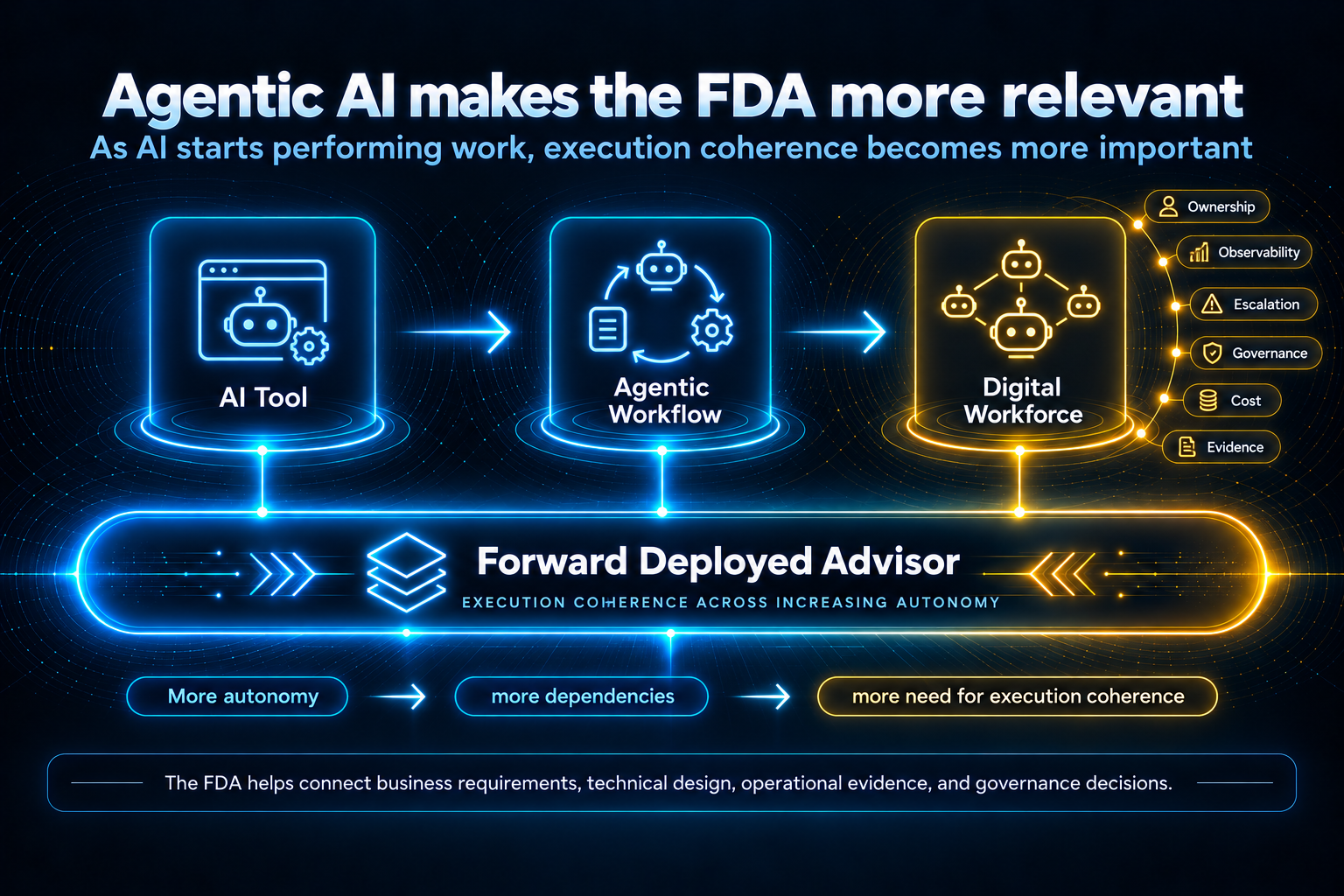
Agentic AI makes the FDA more relevant
Agentic systems may access business context, use tools, perform multiple steps, retry, escalate, act with varying levels of autonomy, and participate continuously in real workflows.
That means implementation increasingly involves not only technology, but operating design: ownership, permissions, verification, observability, escalation, rollback, lifecycle, cost, and human accountability.
FDA does not build the agent harness, engineer the execution loop, manage the Digital Workforce, or run AgentOps — but FDA must increasingly understand enough to connect:
business requirements → technical design → operational evidence → governance decisions
FDA should be able to ask whether greater autonomy is justified by evidence, whether the current Capability Gates have been passed, whether costs remain visible at the business-outcome level, and whether ownership and escalation remain explicit.
As agentic work expands into a Digital Workforce, the FDA can help maintain coherence across business intent, workflow design, technical delivery, reusable Skills, capability dependencies, performance evidence, and governance decisions.
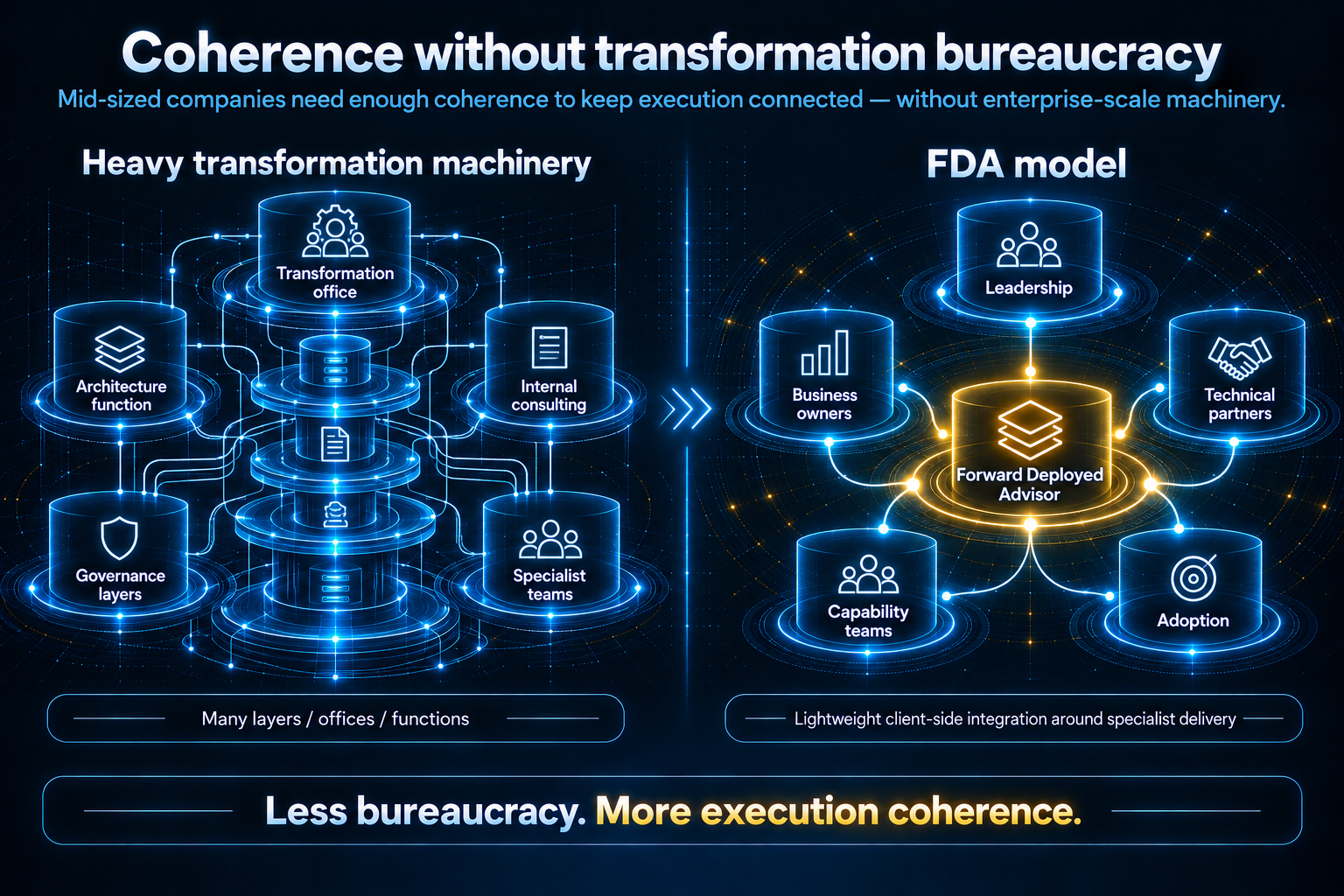
Coherence without transformation bureaucracy
Large enterprises can distribute execution integration across transformation offices, architecture functions, internal consultants, technical teams, governance specialists, and multiple management layers.
Mid-sized companies usually cannot — and should not — recreate that machinery. Yet the interfaces still exist. They may still need:
several AI use cases
internal business owners
external AI and engineering specialists
capability build-up
governance
adoption
XOps
investment decisions
The missing capability is often not another specialist. It is a lightweight integration role that makes the specialists work as one system.
Mid-sized companies do not need enterprise-scale transformation machinery. They need enough coherence to keep execution connected.
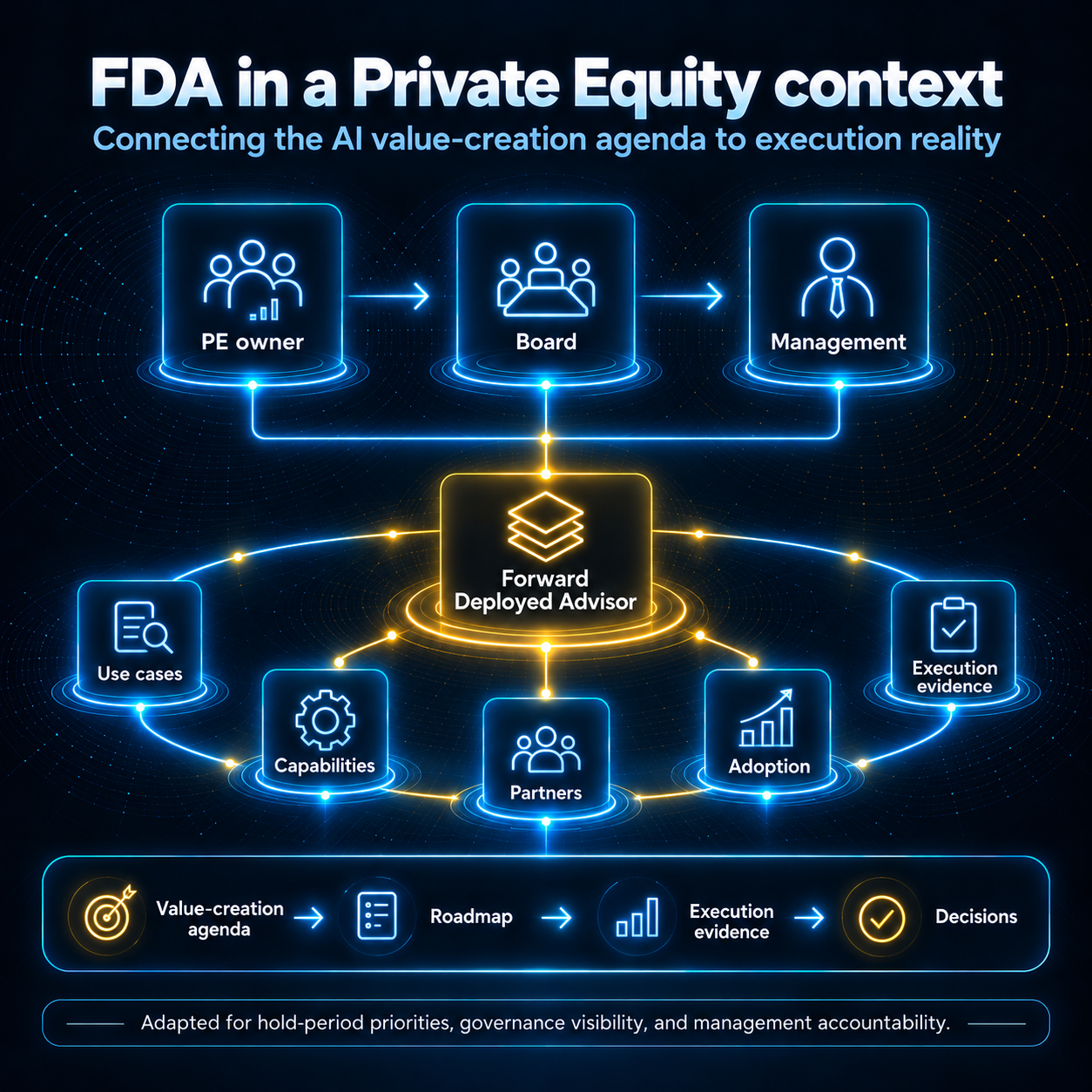
FDA in a Private Equity context
For PE-backed companies, AI execution creates an additional challenge: Management needs enough freedom to execute. Boards need enough visibility to govern. Owners need confidence that AI activity remains connected to the value-creation agenda — without becoming involved in implementation detail.
FDA role can be adapted to keep execution connected to:
the portfolio company’s value-creation priorities
agreed AI use cases and capability investments
board–management commitments
execution evidence and changing assumptions
cost, risk, adoption, and business outcomes
the pace and priorities of the current hold period
The objective is not to create another reporting layer between management and the owner. It is to make decision-relevant execution reality easier to see while preserving clear management accountability.
The FDA role can be adapted to the governance model of the portfolio company — including the intensity of involvement, interaction with management, board reporting cadence, and the level at which execution evidence is synthesized for owner dialogue.
Summary: FDA makes Execution Support tangible
Execution Support service is not simply “help implement the roadmap.”
Its purpose is to carry the reasoning developed during the pre-execution phase into real implementation — while maintaining coherence across use cases, capabilities, partners, adoption, governance, decisions, and outcomes.
The AI at Scale Method provides the strategic context, roadmap logic, execution tools, and decision structure.
By effectively utilizing AI at Scale Method execution system, Forward Deployed Advisor helps keep that logic alive when facing the organizational reality.
To discuss Forward Deployed Advisory in your company context, please fill in the form.