

AI at Scale Method
Clarity and Confidence for AI Decisions and Execution
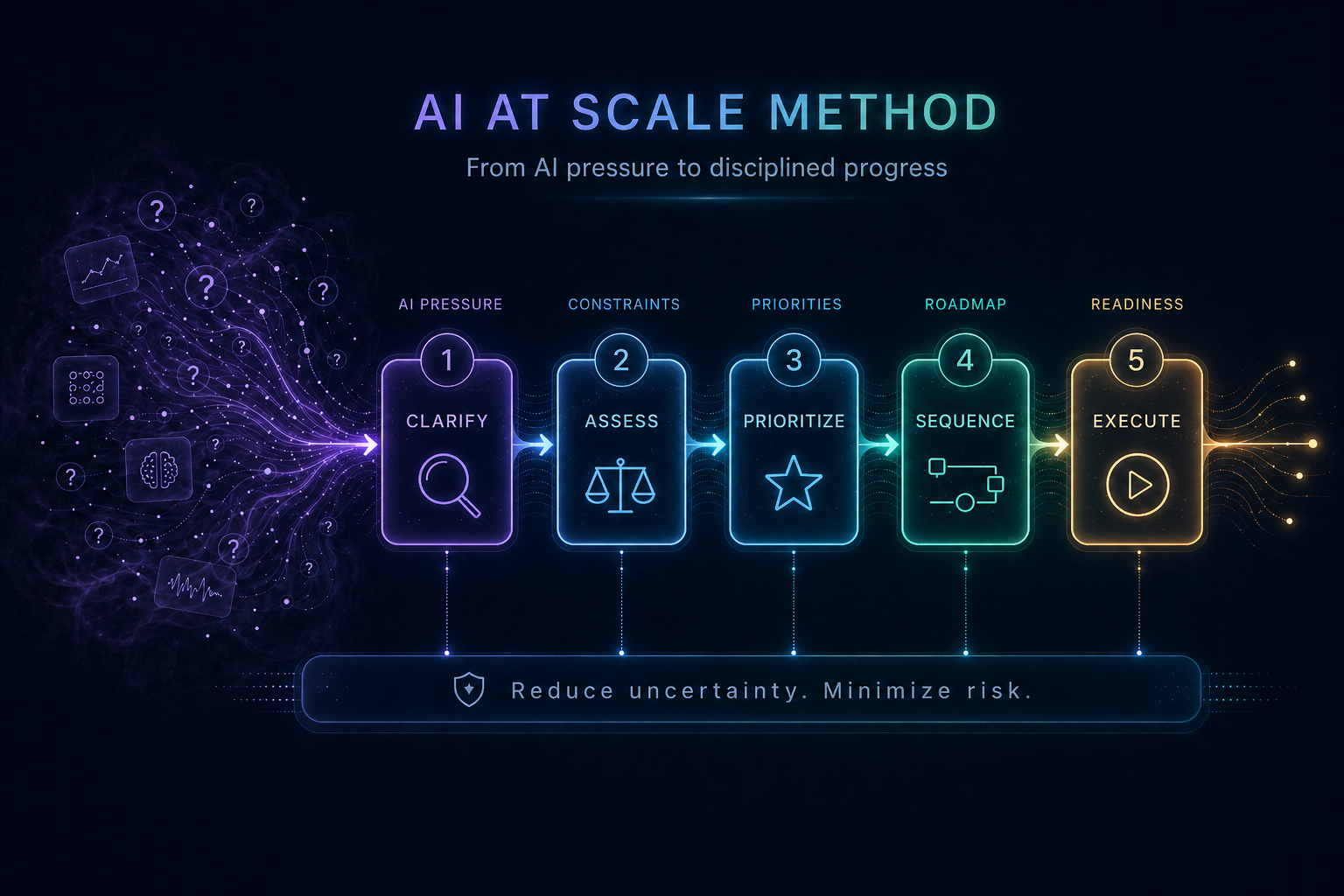
AI at Scale Method is a structured leadership methodology for moving from AI pressure and fragmented ideas to disciplined commitment, credible sequencing, and stronger execution readiness.
It is designed for organizations that need more than AI inspiration. They need a better way to reduce uncertainty before major commitments are made, clarify what matters most, and move toward execution with fewer surprises.
AI at Scale Method is designed for mid-sized companies
Why AI needs a more disciplined decision method
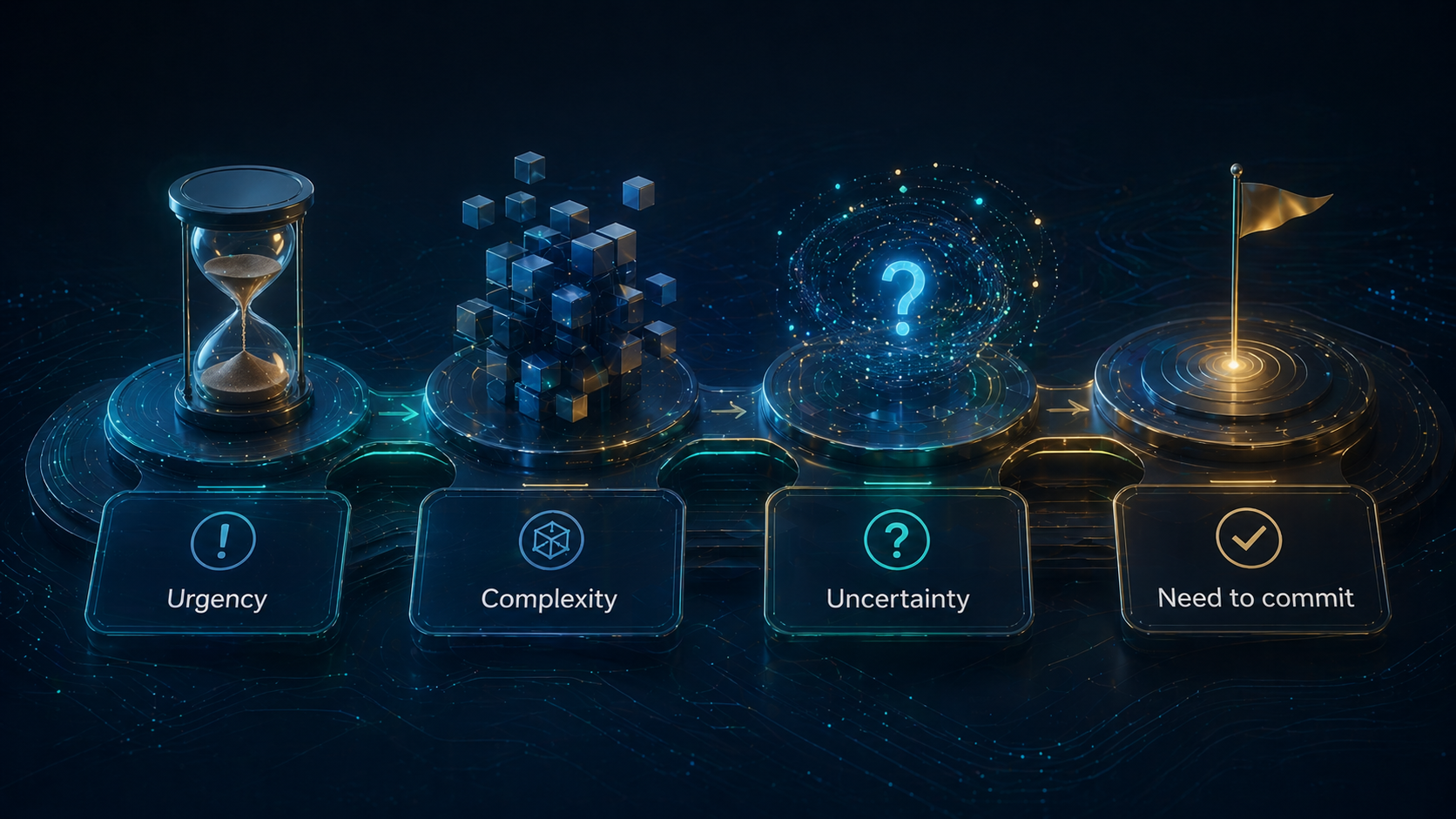
AI is becoming strategically necessary, but leadership teams must often decide before everything is fully knowable.
That is the real challenge.
The issue is not simply whether AI matters. The issue is how to make coordinated commitments on use cases, capabilities, sequencing, and organizational change under real uncertainty. This is the leadership problem that the AI at Scale Method is designed to address.
For mid-sized companies, the challenge is especially sharp. They face the same AI-defined competitive pressure as larger firms, but with less room for waste, fragmented experimentation, or poorly sequenced decisions.
Why AI efforts so often stall
Many AI efforts produce activity, but not disciplined progress.
Organizations experiment with tools, generate disconnected use cases, run pilots, and discuss platforms — yet still struggle to move toward credible commitment and scaled execution.
AI efforts usually do not stall because the technology is mysterious. They stall because organizations move too quickly from interest to action without enough clarity on value, ownership, dependencies, capability sufficiency, and sequencing.
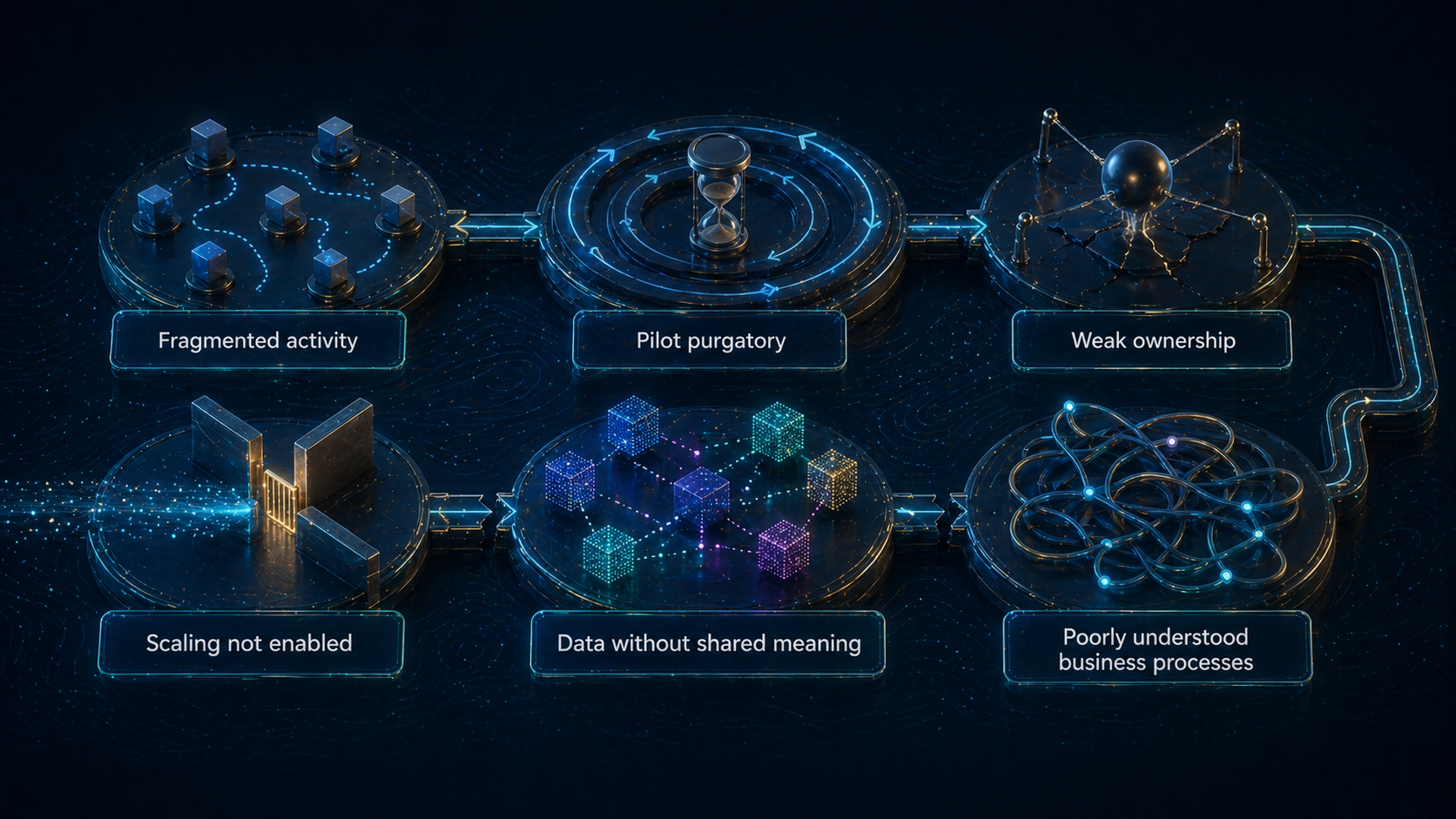
Common breakdown patterns are familiar: fragmented activity, pilot purgatory, weak ownership, scaling not enabled, data without shared meaning, and poorly understood business processes
The point of the AI at Scale Method is not to promise certainty. It is to make these patterns visible early enough to support better decisions before commitment.
What the method is
AI at Scale Method is a structured and evolving leadership methodology for moving from AI ambition to disciplined commitment and execution.
It is not a collection of isolated AI services. It is not a technical delivery framework in disguise.
It is a coherent decision-enablement and execution-readiness method built around uncertainty reduction, use case logic, dependency awareness, and synchronized roadmap design.
Its purpose is simple: to help leadership teams improve clarity, strengthen prioritization, and build more governable commitments before implementation risk compounds.
What it is
Leadership methodology
Decision-enablement system
Sequencing logic
Execution-readiness method
What it is not
Generic AI education
Tool shopping
Disconnected ideation
Architecture-only thinking
Uncertainty before commitment. Risk after commitment.
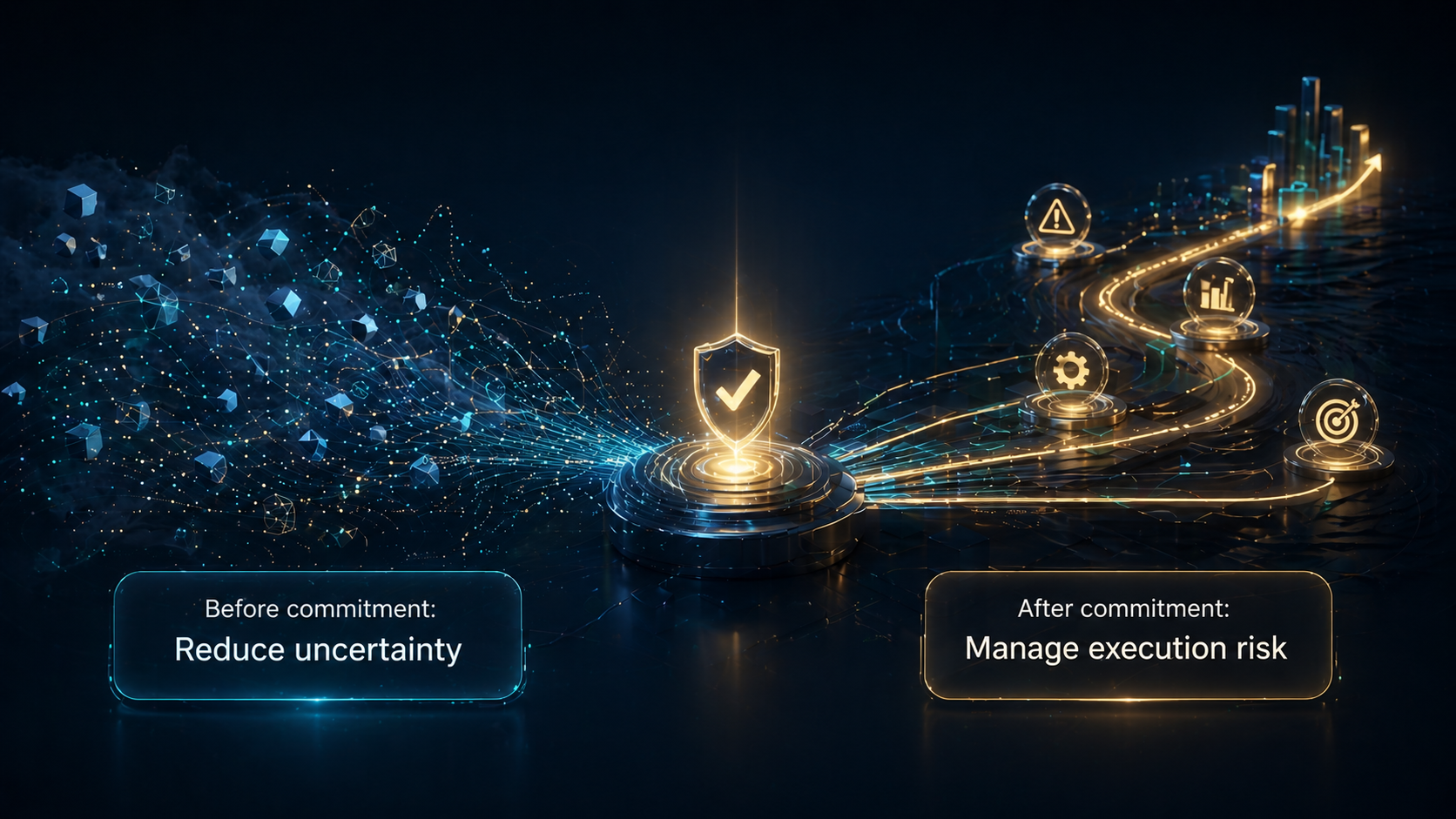
One of the most important principles in the AI at Scale Method is simple:
Uncertainty belongs to decision-making. Risk belongs to execution.
Before commitment, leadership needs better clarity on where AI matters, which use cases deserve attention, what capabilities are sufficient, how difficult integration may become, and what sequencing logic is credible.
After commitment, execution discipline is needed to manage what remains uncertain in practice.
The method therefore focuses first on improving the quality of commitment. It exists to help leadership see more clearly before money, time, and organizational credibility are placed at risk.
The principles behind the method
The AI at Scale Method is built around eight principles that directly address the reasons AI efforts typically derail.
Principle 1 — Decision-first logic
Everything before execution exists to improve the quality of commitment and reduce the probability of costly missteps later.
Principle 2 — Uncertainty before commitment, risk after commitment
Temporal logic: uncertainty belongs to decision-making, while risk belongs to execution.
Principle 3 — Use cases as the practical glue
AI use cases connect strategy, value creation, capability needs, integration realities, and sequencing decisions. They are the units of transformation and integration.
Principle 4 — Capability realism over abstract maturity
The important question is not “How mature are we?” but whether capabilities are strong enough for the use cases the organization wants to pursue.
Principle 5 — Dependency-aware planning
Integration is dependency management, not merely system connection. Selected use cases place pressure on specific capability surfaces, and that pressure must be understood before commitment.
Principle 6 — Failure-pattern awareness
Predictable failure patterns justify better preparation. They are not accidents but recurring signals that ambition is outrunning readiness.
Principle 7 — Capability-based commitment
Capability gates create discipline where calendar promises create pressure. Readiness matters more than optimism.
Principle 8 — Compound value across connected steps
Each step improves the quality and usefulness of the next one. The method gains strength through connection, not through isolated interventions.
How the method works
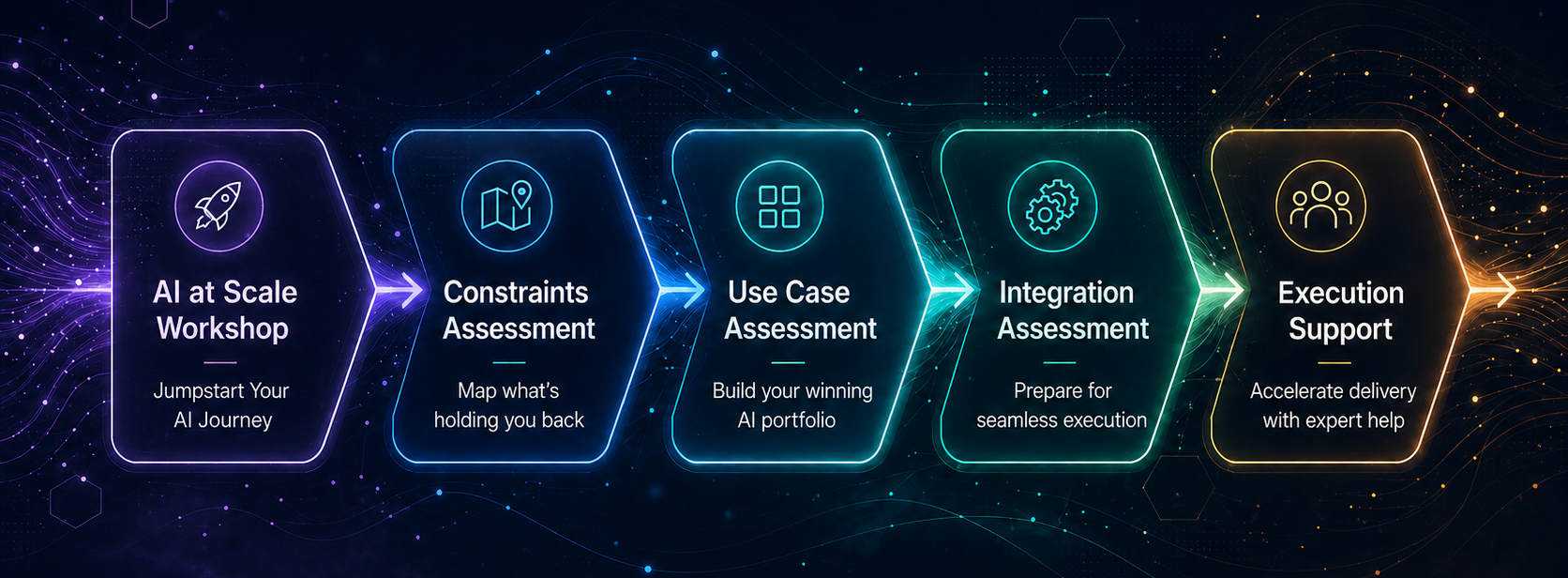
The AI at Scale Method works through a connected sequence in which each step reduces uncertainty and improves the usefulness of the next step.
The logic is simple: Work backward from the point where leadership must decide what to pursue, in what order, and with what level of commitment.
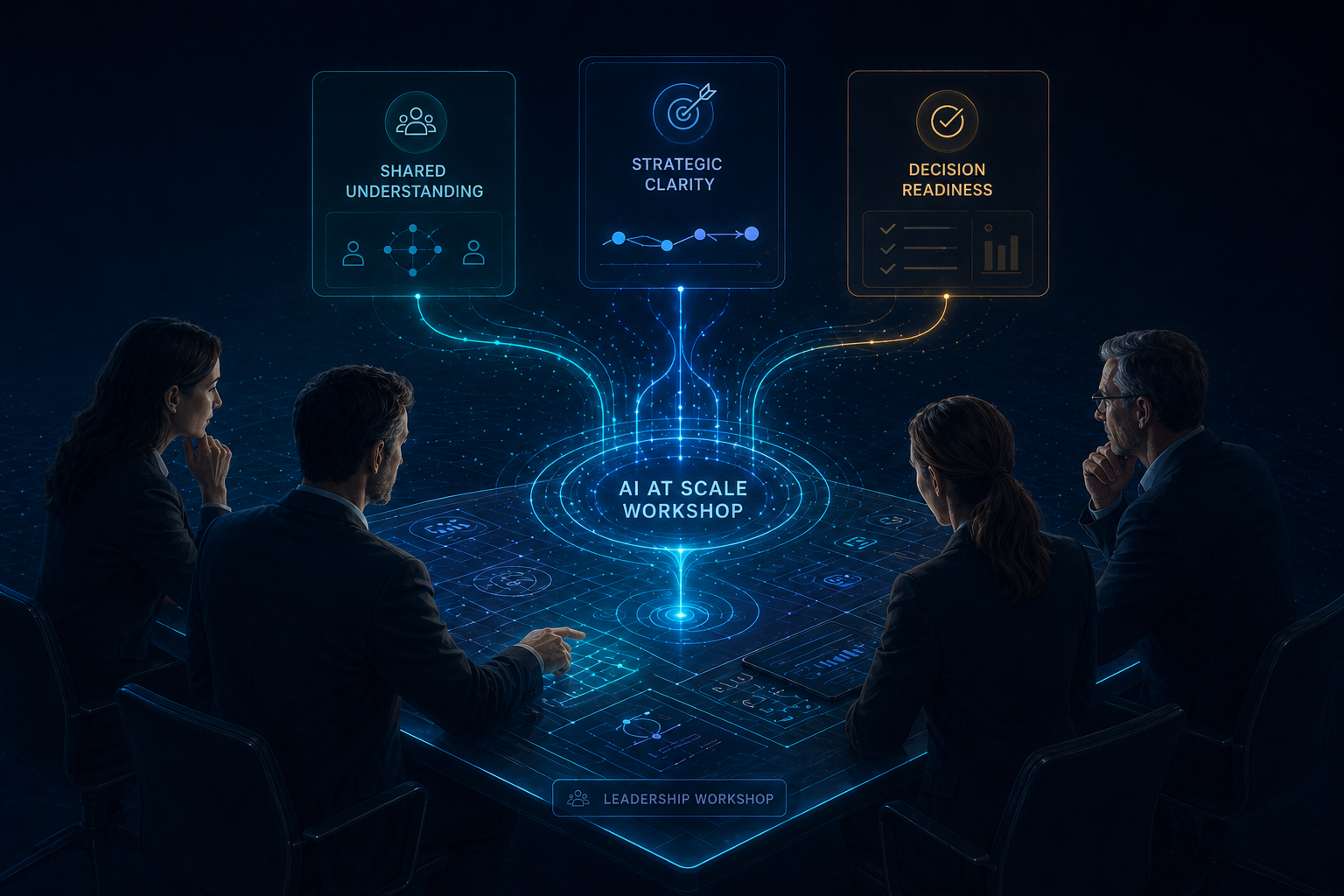
AI at Scale Workshop
Build shared language, strategic clarity, and decision readiness.
Constraints Assessment
Establish a forward-looking capability baseline and reveal structural bottlenecks.
Use Case Assessment
Identify and shape a coherent, business-aligned AI use case portfolio.
Integration Assessment
Translate selected use cases into dependency-aware sequencing and roadmap logic.
Execution Support
Carry roadmap logic into implementation, adoption, and measurable progress.
Each step delivers standalone value, but the full strength of the method lies in how understanding compounds across the flow.
What the method helps leadership clarify
The AI at Scale Method works by making a set of practical questions more visible and more answerable before commitment.
These five questions are at the heart of the wider portfolio logic and provide a clean web-level summary of the method.
Question 1: What does AI at Scale mean for our business?
Question 2: What is currently holding us back?
Question 3: Which use cases matter most?
Question 4: What would it take to integrate them responsibly?
Question 5: How do we move into execution with confidence?
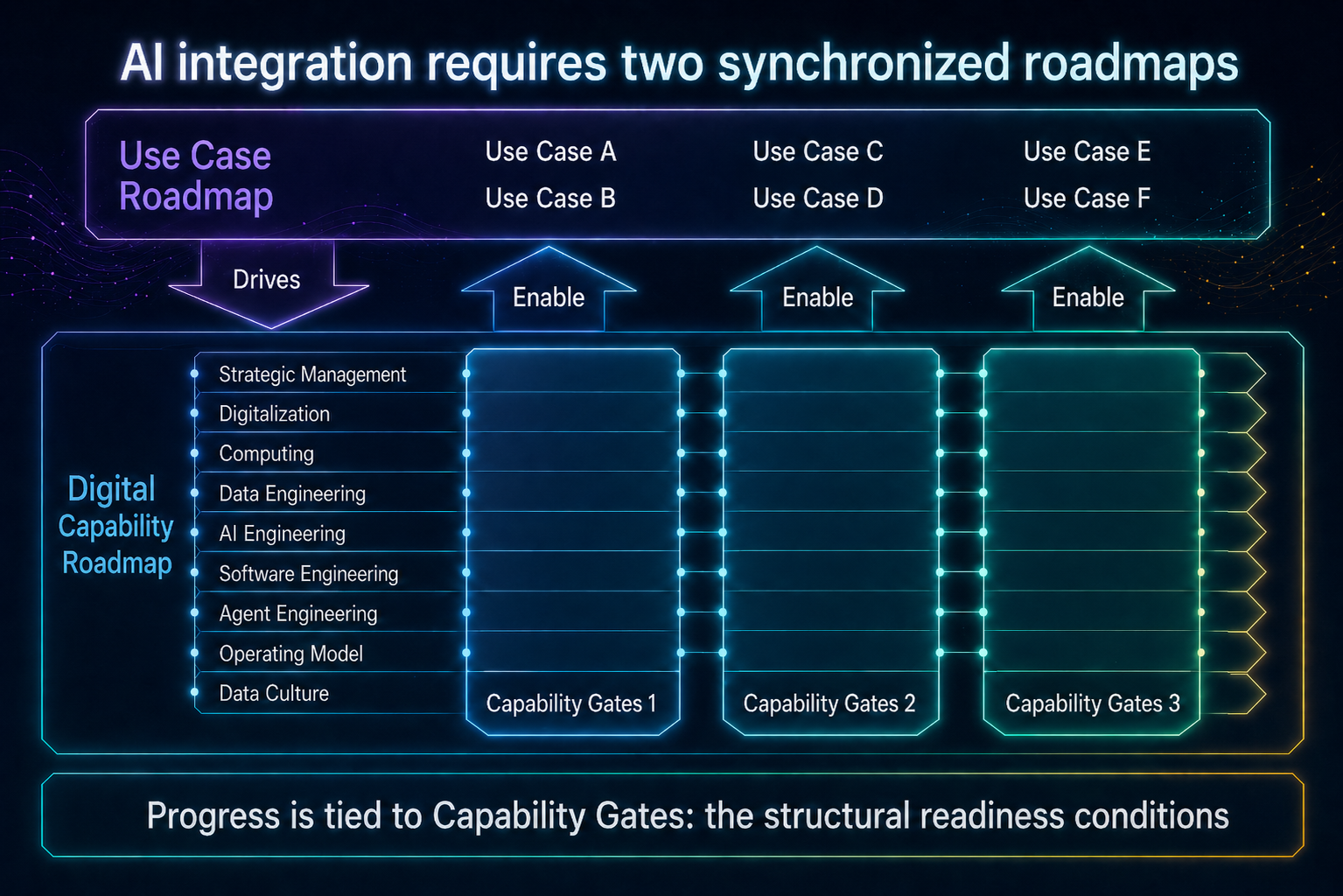
The output: Dual Roadmap
The AI at Scale Method ultimately leads to two inseparable deliverables:
Use Case Roadmap
Digital Capability Roadmap
They cannot be designed independently.
Use cases activate capability dependencies. Capabilities unlock use cases. The role of the method is to make that relationship visible and governable.
That is why the method does not stop at identifying opportunities. It aims to create a planning logic in which value, feasibility, constraints, and sequencing can be understood together.
Use cases drive. Capabilities enable.
From agentic leverage to embedded advantage
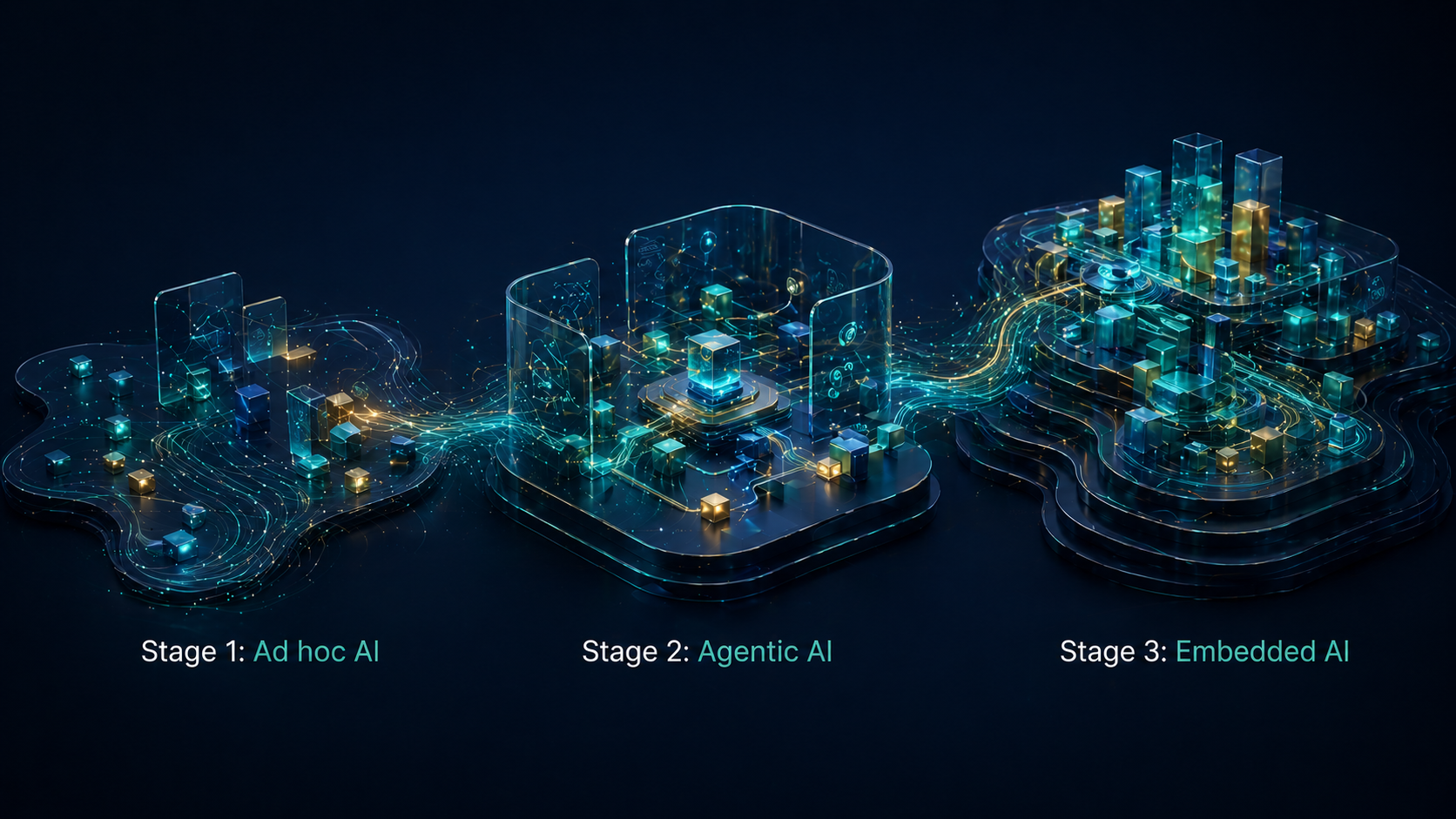
AI at Scale is not one leap. It is a journey.
Ad hoc AI is the first natural and easy step with uncoordinated AI tool deployment and trialling.
For many mid-sized companies, the most realistic near-term opportunity lies in Agentic AI and orchestrated AI systems that create meaningful leverage without requiring full digital capabilities maturity immediately.
Over time, the deeper strategic opportunity often lies in Embedded AI capabilities inside products, services, and systems.
AI at Scale Method helps leadership navigate that journey more deliberately by connecting ambition, capabilities, and sequencing.
Built for mid-sized companies
AI at Scale Method is especially relevant for mid-sized companies because they need disciplined progress more than sheer volume of activity.
They face strong competitive pressure, but usually with less budget, less engineering capacity, and less tolerance for wasted effort than larger enterprises.
The method is designed to help leadership make sharper choices, reduce avoidable missteps, and build a more credible path from ambition to execution.

From method to practical support
The AI at Scale Method is not just an abstract framework. It is embodied in a connected sequence of practical services, beginning with the AI at Scale Workshop and continuing through three analytical steps toward the Dual Roadmap and execution support.
If your leadership team needs a better way to think about AI priorities, capability sufficiency, use cases, integration realities, partnering, and sequencing, the best place to start is the AI at Scale Workshop. It is the front end of the overall AI at Scale Method.