

AI at Scale Method for Private Equity
A structured method for portfolio company governance in the Age of AI
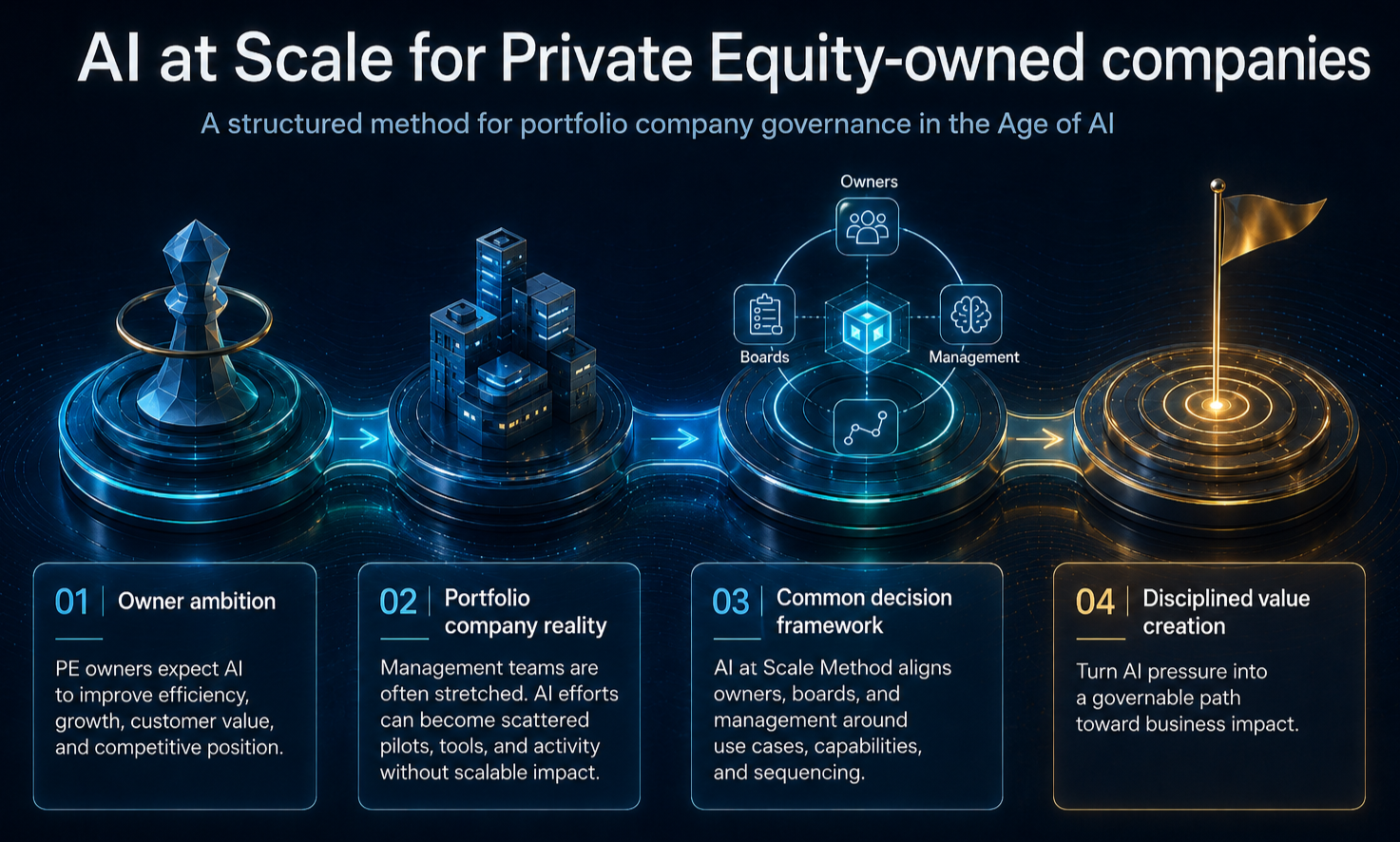
Private Equity owners increasingly expect portfolio companies to use AI to improve operational efficiency, accelerate growth, strengthen customer value, and protect competitive position.
But management teams are often already stretched. Pressure to “do more with AI” can easily produce scattered pilots, tool experimentation, and activity without a clear path to scalable business impact.
AI at Scale Method gives owners, boards, and management teams a common framework for turning AI pressure into disciplined value creation.

From “do more with AI” to a governable agenda
AI is increasingly becoming part of the value-creation agenda for PE-owned companies.
The problem is rarely lack of activity. Portfolio companies may already have AI tools, pilots, vendor initiatives, and individual experiments underway.
The harder questions are:
Where can AI materially improve EBITDA, growth, customer value, or strategic positioning?
Which use cases deserve attention now?
Which capability gaps constrain progress?
What requires preparation before commitment?
What should realistically happen during the current hold period?
How can the board challenge management constructively without creating fragmented AI activity?
The objective is not more AI activity.
The objective is disciplined progress toward business value.
A common decision framework for owners, boards and management
AI at Scale Method is a structured leadership methodology for moving from AI uncertainty to disciplined action.
Applied in a PE context, it creates a shared framework for discussing AI value creation across the ownership and management dialogue.
It helps move the conversation beyond:
Which AI tools should we use?
How many pilots are running?
Are we doing enough with AI?
Toward more consequential questions:
Where does AI create business leverage?
What should we prioritize?
What are we realistically capable of executing?
What needs to be strengthened first?
What should we commit to now — and what should wait?
The result is a stronger basis for AI-related governance, investment decisions, and execution.

AI as a disciplined value-creation agenda
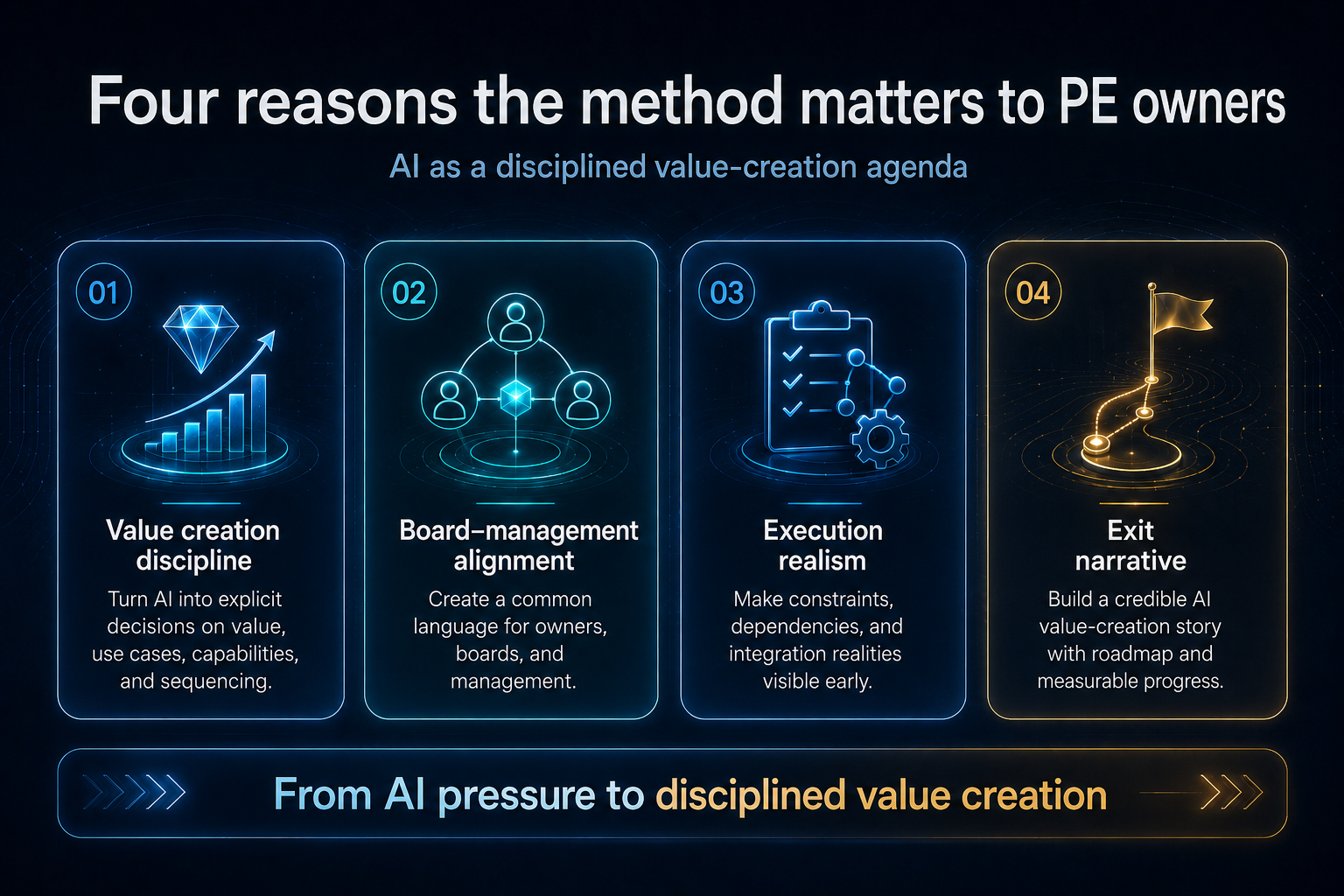
Value creation discipline
Turn AI from a broad strategic theme into explicit decisions about business value, use cases, capabilities, and sequencing.
Board–management alignment
Create a common language for owners, boards, and management teams — enabling constructive challenge without encouraging fragmented activity.
Execution realism
Make constraints, dependencies, integration requirements, and familiar failure patterns visible before major commitments are made.
Exit narrative
Move from “we are experimenting with AI” toward a credible AI value-creation story supported by a roadmap, visible capability build-up, and measurable use case progression.
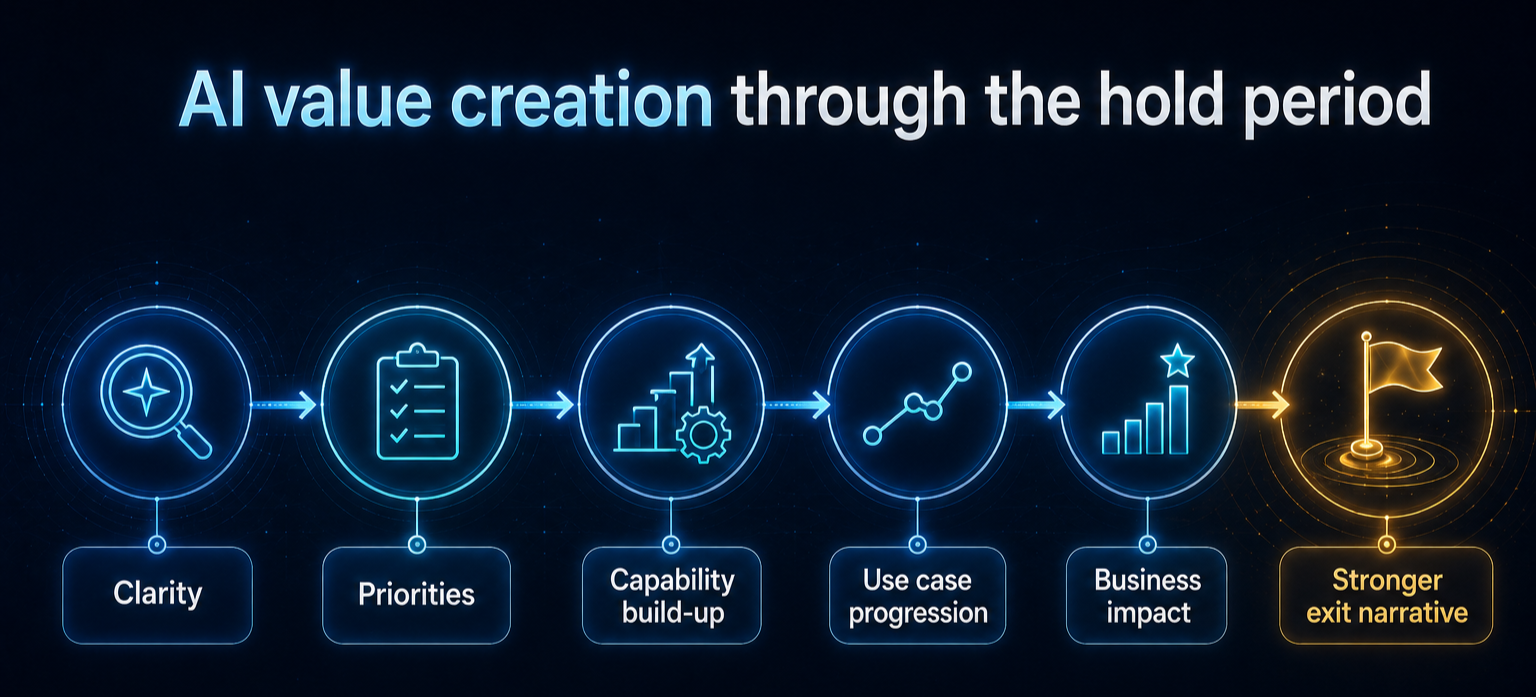
AI value creation through the hold period
AI value creation does not require every portfolio company to launch a large transformation program.
The more useful question is what level of commitment is justified now.
AI at Scale Method helps leadership distinguish between:
What creates value now - Use cases that can generate meaningful results with existing or readily accessible capabilities.
What requires preparation - High-value opportunities that depend on stronger data, processes, technology, operating models, or other capabilities.
What belongs later - More ambitious opportunities whose timing should follow structural readiness rather than optimism.
This creates a more credible way to connect AI ambition with the realities of the hold period.
A semi-permanent AI execution resource
Method. Embedded continuity. Owner-level visibility.
Private Equity owners do not necessarily need another AI consultant who produces recommendations and then steps away.
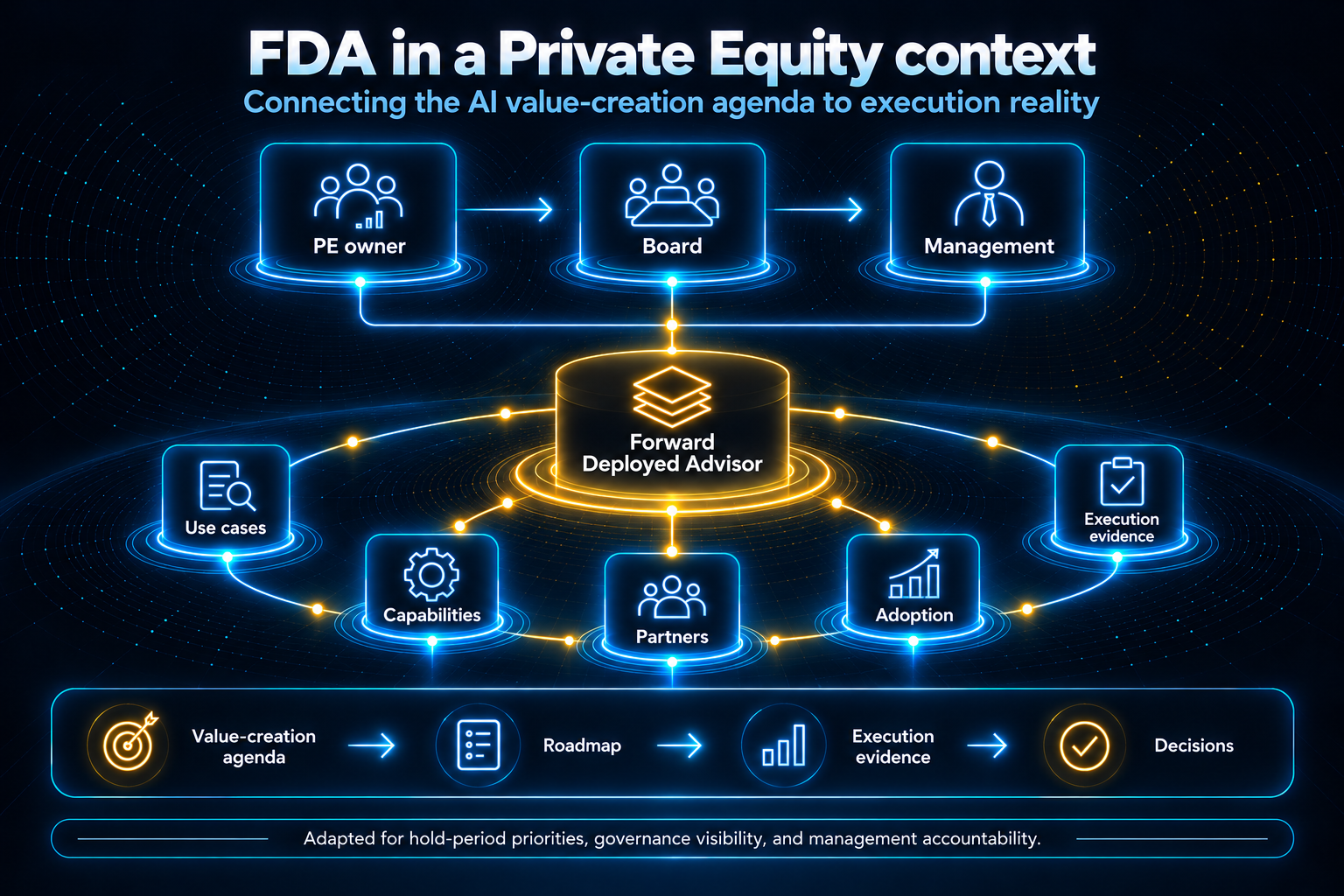
They often need something harder to find: A trusted, client-side resource that can stay close to the portfolio company, help management turn AI ambition into execution, and give owners and boards unusually good visibility into whether the value-creation agenda is actually progressing.
Tuulor's Forward Deployed Advisor model is designed for that role.
The FDA can be deployed as an embedded, semi-permanent execution resource — working alongside management, business owners, technical partners, and capability teams while preserving clear management accountability.
The proposition combines three capabilities:
1. A systematic execution method
Forward Deployed Advisor does not operate from personal intuition alone.
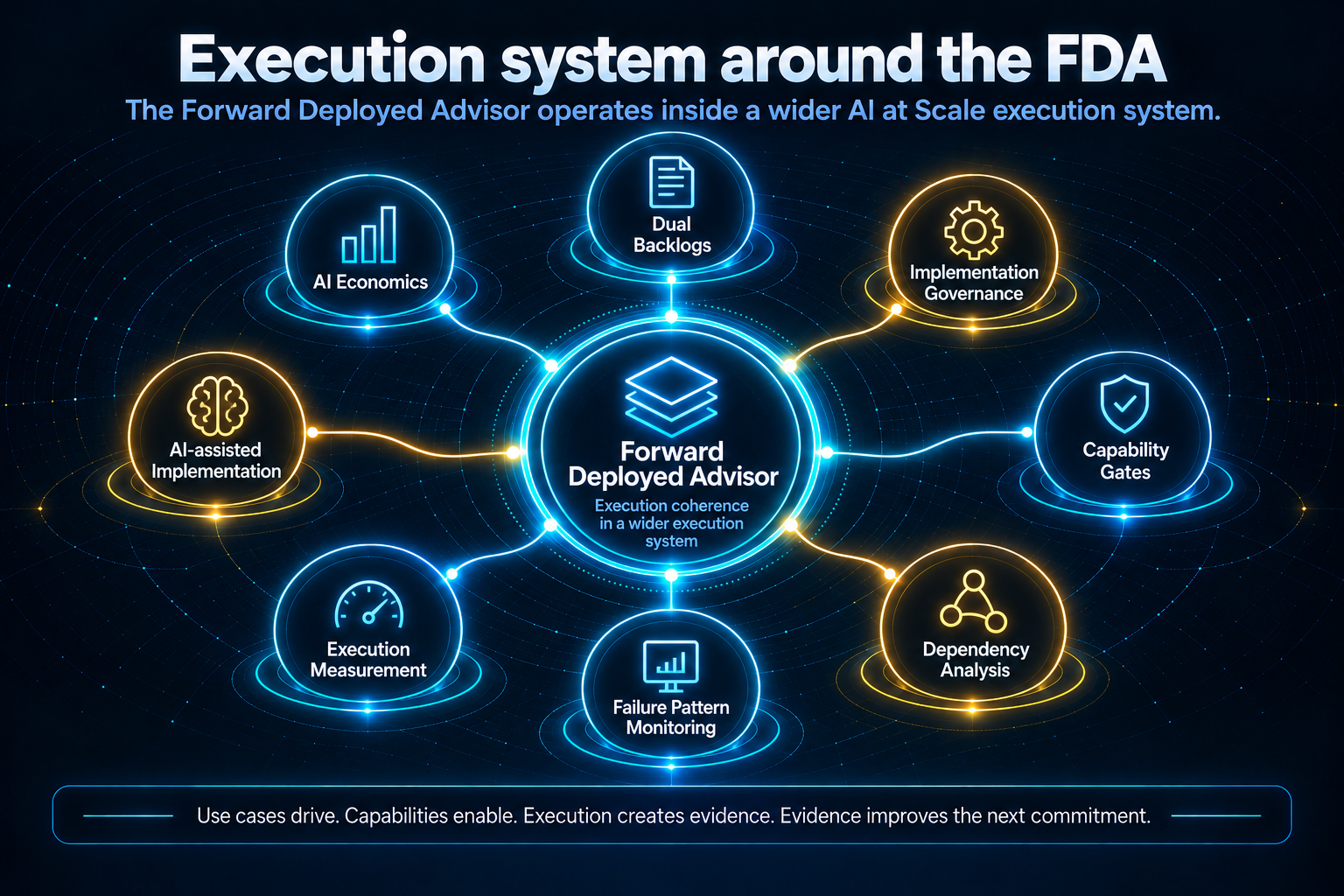
The role is backed by the AI at Scale Method and its Execution System — a structured set of execution disciplines that help carry strategic intent into implementation.
Depending on the situation, these include:
Dual Backlogs
Implementation Governance
Capability Gates
Dependency Analysis
Failure Pattern monitoring
Execution Measurement
AI-assisted implementation
AI economics and investment discipline
Together, these provide a repeatable way to keep use cases, capability build-up, partners, adoption, economics, risks, and decisions connected as execution evolves.
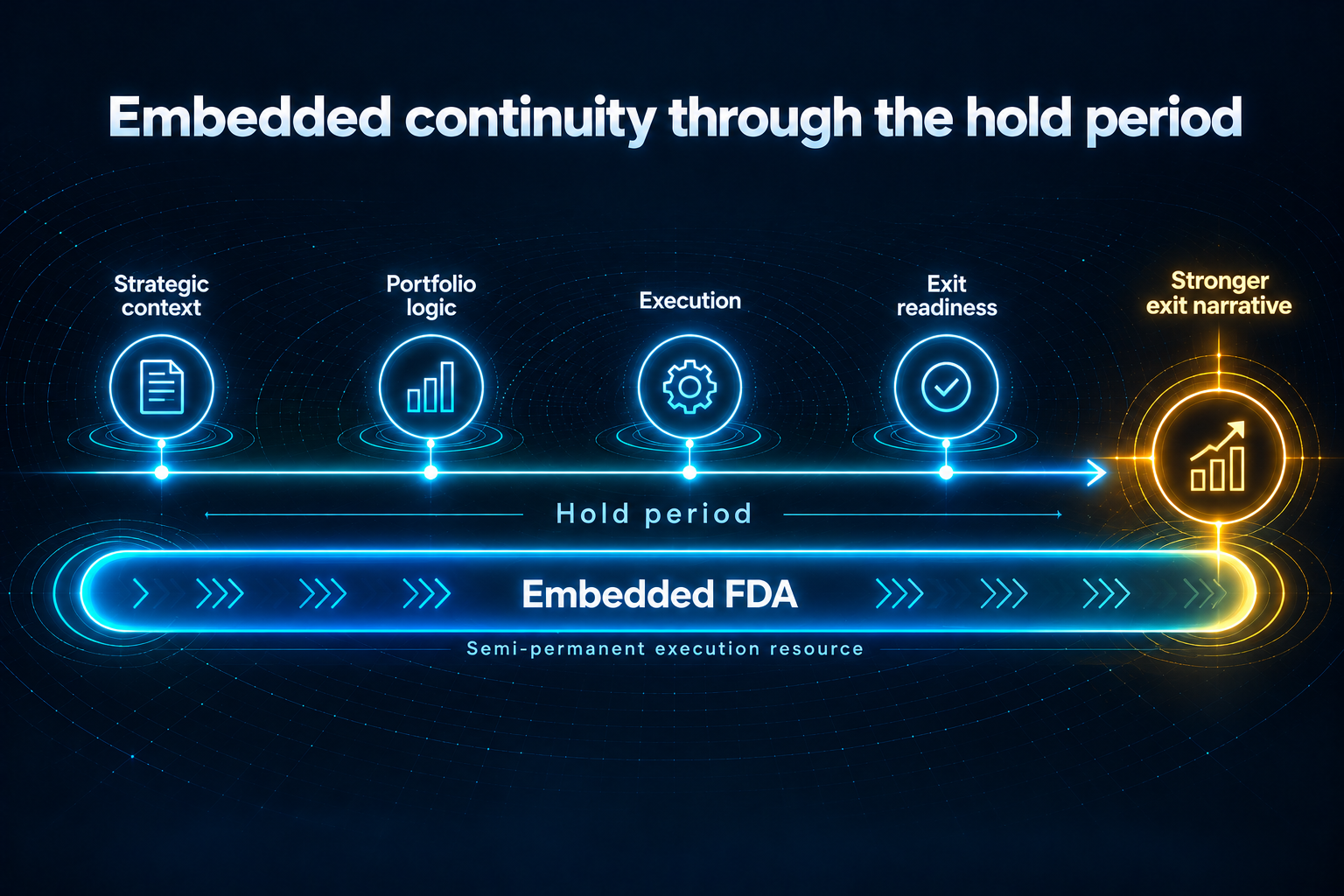
2. Embedded continuity through the hold period
The FDA can provide continuity that episodic advisory work cannot.
Where Tuulor has already participated in the Workshop, Constraints Assessment, Use Case Assessment, or Integration Assessment, the advisor enters execution with deep context:
leadership intent
capability reality
use case portfolio logic
roadmap reasoning
key dependencies
partnering choices
assumptions behind sequencing
known execution risks
That knowledge compounds. Instead of reconstructing the rationale behind previous decisions, the FDA can carry it forward into implementation — and update it as new evidence emerges.
The role can be adapted to one portfolio company or, where appropriate, to a small group of portfolio companies requiring similar execution discipline.
3. Exceptional owner and board visibility
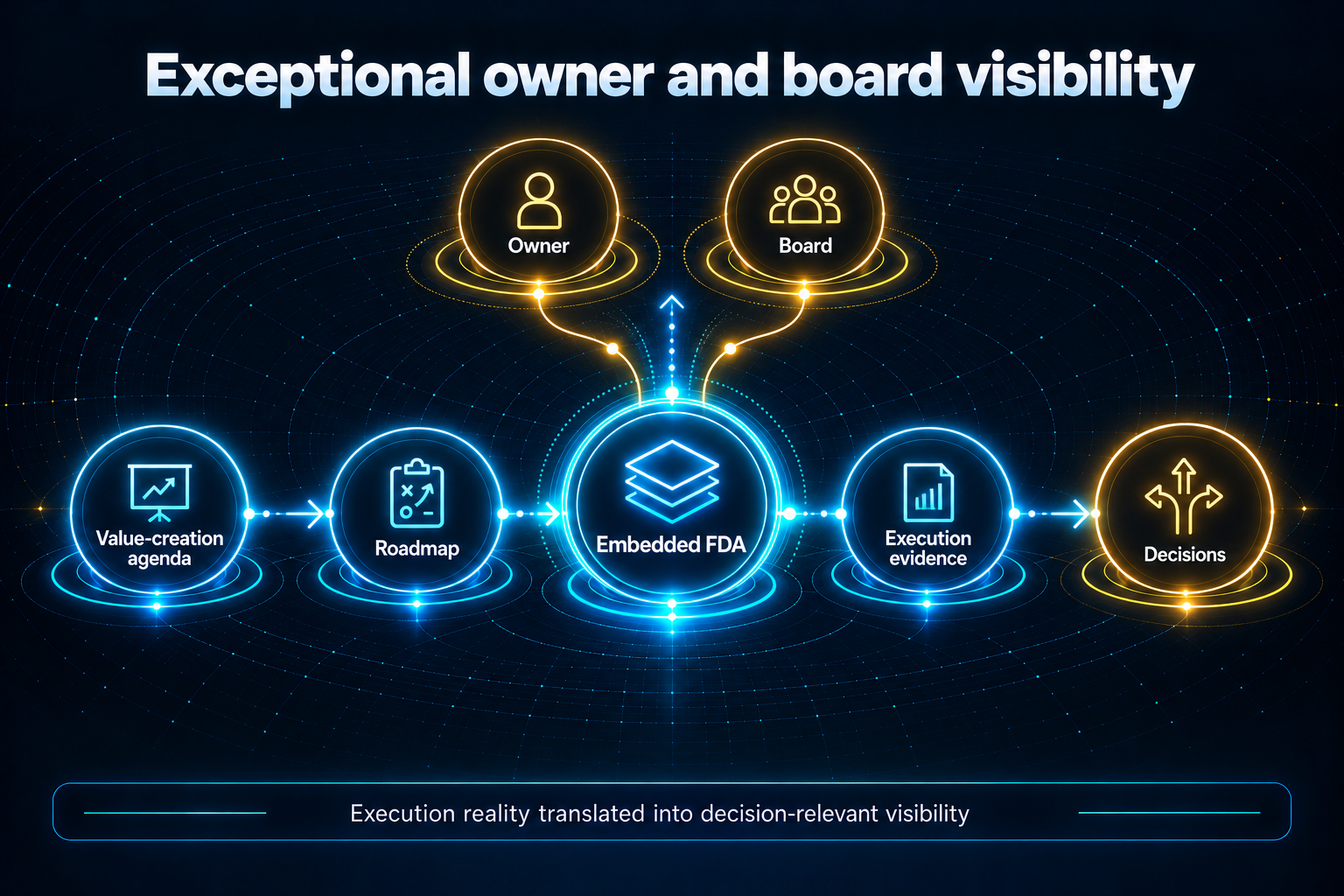
For PE owners, execution visibility matters. But owners and boards do not need engineering tickets or technical activity reports. They need to know whether AI is progressing as a value-creation agenda.
The FDA can help translate implementation reality into decision-relevant signals such as:
business outcome progression
use case portfolio progress
capability investment and readiness
material dependencies
adoption
changing economics
execution risk
partner performance
assumptions that no longer hold
decisions that require board or owner attention
The objective is not to create another reporting bureaucracy. It is to create a clearer line of sight from: Value-creation agenda → Roadmap → Execution evidence → Decisions
One role. Clear accountability.
The Forward Deployed Advisor does not replace portfolio company management.
The accountability model remains clear:
Leadership owns the commitments.
Business owners own the outcomes.
Technical partners own their deliverables.
The Forward Deployed Advisor owns the coherence.
The FDA can work deeply inside the execution system while preserving management responsibility and giving the board and owner better visibility into what actually matters.
This is not outsourced management. It is AI execution intelligence.

Adapted to the PE context
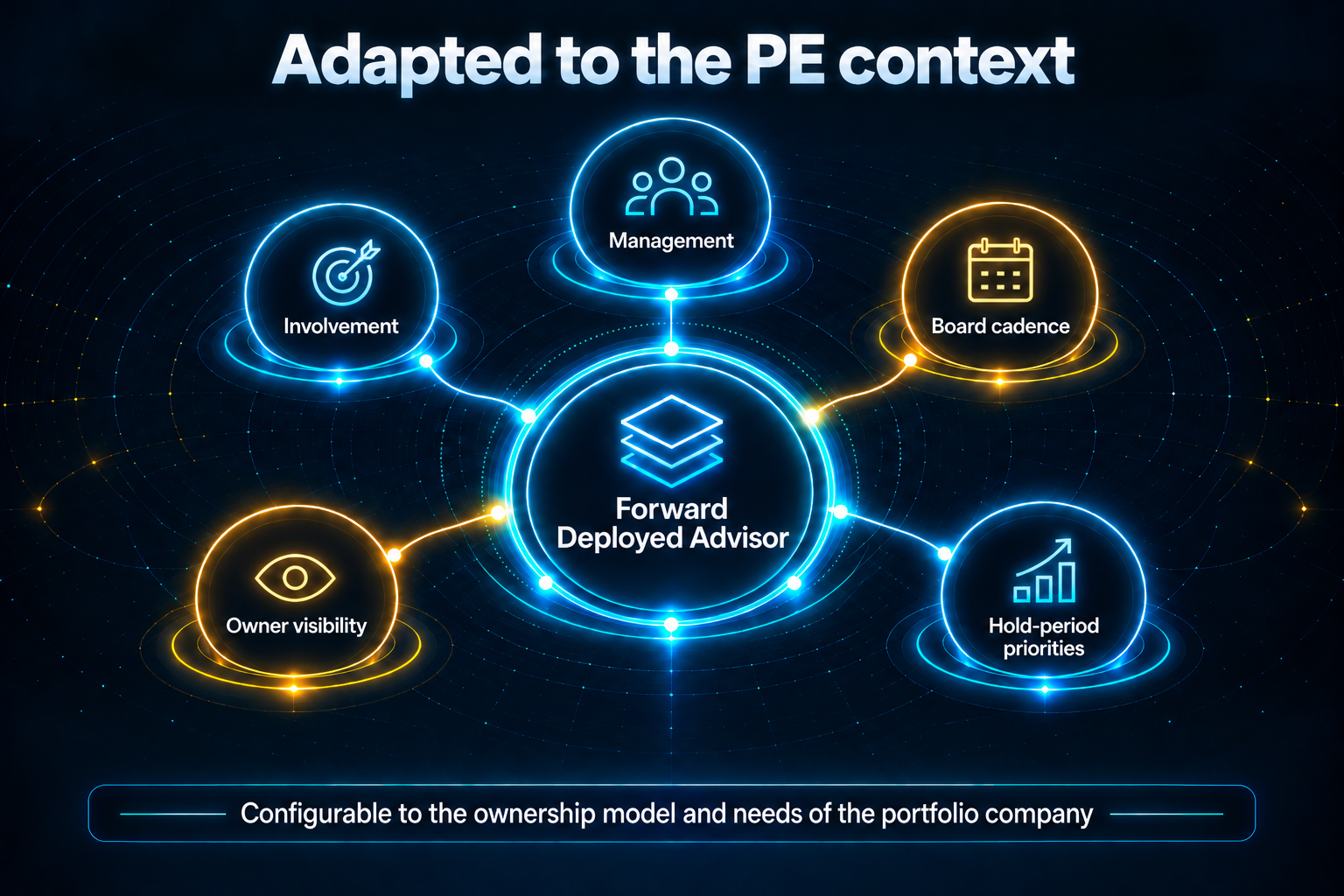
The FDA mandate can be adapted to the ownership model and needs of the portfolio company, including:
intensity of involvement
one-company or selected multi-company deployment
interaction with CEO and management team
relationship with technical and implementation partners
board reporting cadence
owner-level synthesis
hold-period priorities
decision and escalation thresholds
The guiding principle remains the same: Stay close enough to execution to understand reality, while remaining high enough above specialist work to protect value, ownership, sequencing, and business intent.
A powerful way to make AI happen
AI at Scale Method provides the structure.
The Forward Deployed Advisor provides continuity.
Execution evidence gives owners and boards visibility into whether the value-creation agenda is becoming real.
For PE owners, that creates a powerful operating model: Systematic AI execution without building a large internal transformation organization — and without losing management accountability.
Start with leadership alignment
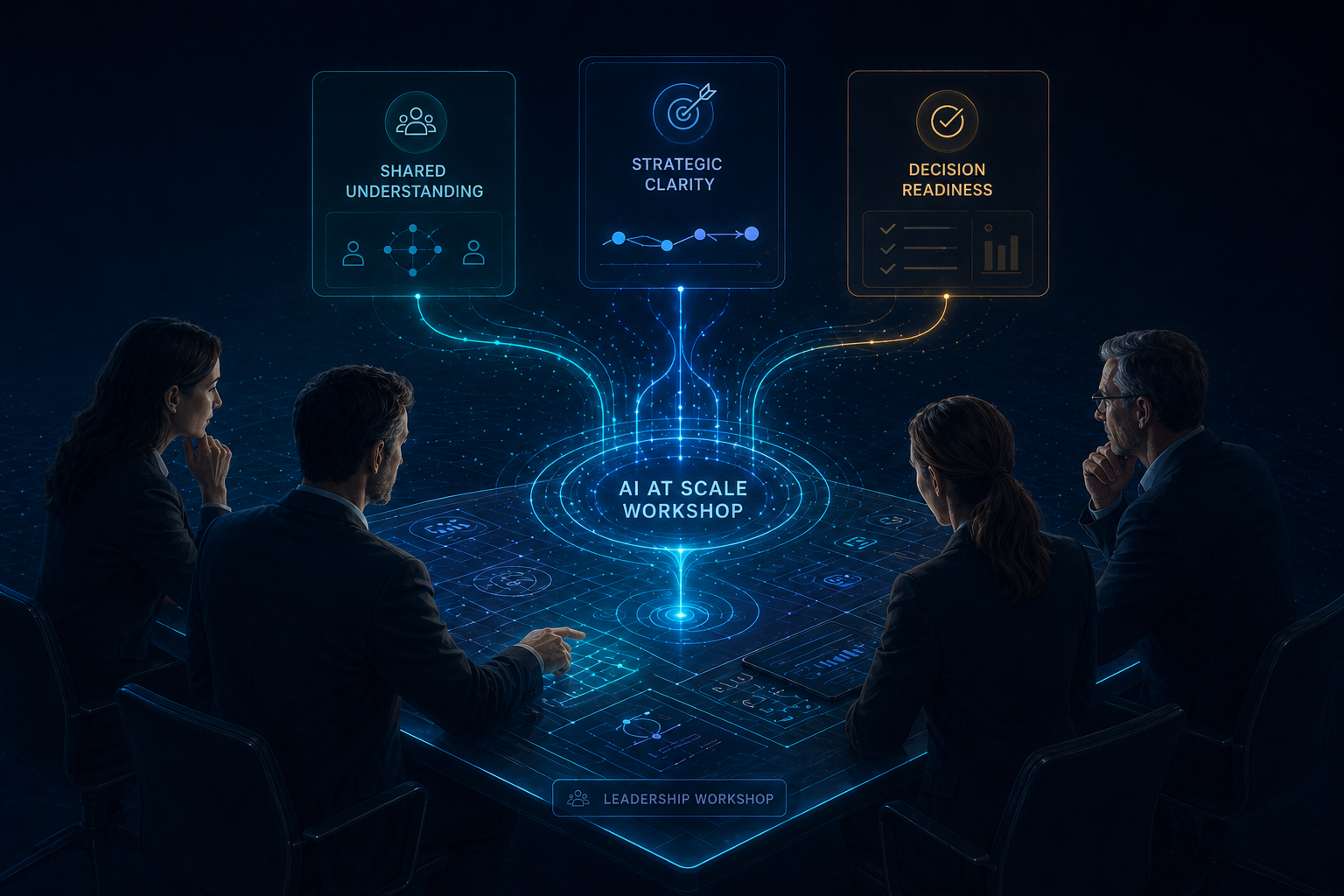
The practical starting point is the AI at Scale Workshop.
It is a structured leadership workshop designed to build shared language, strategic clarity, and decision readiness before larger AI commitments are made.
For a PE-owned company, the Workshop creates a structured forum for aligning perspectives on:
where AI matters most
which opportunities deserve attention
what may constrain progress
what responsible commitment requires
what should happen next
Where deeper work is justified, the broader AI at Scale Method continues from leadership alignment into capability constraints, use case prioritization, integration planning, sequencing, and execution support.
Bring discipline to the AI value-creation agenda
AI creates both opportunity and pressure for PE owners.
The answer is neither to wait nor to push portfolio companies into disconnected AI activity.
A better starting point is a common method for deciding where AI matters, what deserves commitment, what requires preparation, and how progress should be sequenced.
If you are considering how AI should fit into the value-creation agenda of one or several portfolio companies, let’s discuss whether AI at Scale Method could provide a useful framework.